By Sam Jacobs
“In America we say if anyone gets hurt, we will ban it
for everyone everywhere for all time. And before we know it, everything
is banned.”
It’s a common refrain: We have bubble-wrapped the world. Americans in
particular are obsessed with “safety.” The simplest way to get any law
passed in America, be it a zoning law or a sweeping reform of the
intelligence community, is to invoke a simple sentence: “A kid might get
hurt.”
Almost no one is opposed to reasonable efforts at making the world a
safer place. But the operating word here is “reasonable.” Banning lawn darts,
for example, rather than just telling people that they can be dangerous
when used by unsupervised children, is a perfect example of a craving
for safety gone too far.
Beyond the realm of legislation, this has begun to infect our very culture. Think of things like “trigger warnings” and “safe spaces.”
These are part of broader cultural trends in search of a kind of
“emotional safety” – a purported right to never be disturbed or offended
by anything. This is by no means confined to the sphere of academia,
but is also in our popular culture, both in “extremely online” and more mainstream variants.
Why are Americans so obsessed with safety? What is the endgame of
those who would bubble wrap the world, both physically and emotionally?
Perhaps most importantly, what can we do to turn back the tide and
reclaim our culture of self-reliance, mental toughness,
and giving one another the benefit of the doubt so that we don’t
“bankrupt ourselves in the vain search for absolute security,” as
President Dwight D. Eisenhower warned us about?
Coddling and Splintering: The Transformation of the American Mind
 Two books published in 2018 provide parallel insights into the problems presented by the safety obsession of American culture: The Splintering of the American Mind by William Egginton, focused on the tendency of Americans to tunnel themselves off into self-selected bubbles, and The Coddling of the American Mind by Greg Lukianoff and Jonathan Haidt, which deals more with the tendency to avoid any uncomfortable or unpleasant information.
There is an interesting phenomenon involved in coddling: Australian
psychologist Nick Haskam first coined the term “concept creep.”
Basically, this means that terms are often elastic and expand past the
point of meaning. Take, for example, the concept of “trauma.”
This used to have a very limited meaning. However, “trauma” quickly
became expanded to mean even slight physical or emotional harm or
discomfort. Thus the increasing belief among the far left that words can
be “violence” – not “violent,” mind you, but actual, literal violence.
In the other direction, the definition of “hero” has been expanded
to mean just about anything. Every teacher, firefighter and police
officer is now considered a “hero.” This isn’t to downplay or minimize
the importance of these roles in our society. It’s simply to point out
that “hero” just doesn’t mean what it used to 100 or even 30 years ago.
Once this expansion of a term occurs, there is never any kind of
retraction. Trauma now means just about anything, and violence will soon
be expanded to include lawful, peaceful speech that one disapproves of.
Once this happens, there will be no going back. In the words of Sam Harris:
“We (as a society) have to be committed to defending free speech
however impolitic, or unpopular, or even wrong because defending that is
the only barrier to violence. That's because the only way we can
influence one another short of physical violence is through speech,
through communicating ideas. The moment you say certain ideas can't be
communicated you create a circumstance where people have no alternative
but to go hands on you.”
It is extremely dangerous to begin labelling everything as violence
for reasons of free speech, but perhaps even more dangerous is the
notion that when anything is violence, nothing is violence. Redefining
words as “violence” means that we have little recourse for when actual
violence occurs.
The Coddling of the American Mind notes some other concepts
that are important as we speak of America’s obsession with “safety”
above all else. First, that coddling combined with splintering means
that people’s political views are much more like fanatical religious
views than anything. They don’t see themselves as having to debate ideas
or seek common ground. Rather, the opposing side and its proponents are
seen as “dangerous” and must be discredited at all costs. It is worth
noting that this is much more common among the left than the right or
the center, which has now become more the place where “live and let
live” types congregate.
The problem with this goes beyond simply being irritated by
irrational people barking at you or at someone else: There is an entire
generation of people who are seriously lacking in critical thinking skills.
They think that labelling people and name-calling are excuses for a
reasoned argument. In the words of Voltaire, “Those who can make you
believe absurdities can make you commit atrocities.”
These problems are hardly confined to political radicalism or
academia. Indeed, the corporate sector is no stranger to this kind of
safety obsession. There is the phenomenon of “woke capital,” where the
corporations find the latest celebrity cause-du-jour and use it as a
marketing strategy.
There is currently an extreme risk aversion in management science.
Companies will now do basically anything to avoid “a kid getting hurt”
or someone’s delicate sensibilities being offended.
Education from kindergarten up to the universities
is increasingly about teaching doctrines and ideology, rather than
critical thinking and problem solving skills. All of this is a dangerous
admixture that combines the full weight of the academic, cultural and
business elites in this country. And its consequences are far reaching.
Trigger Warnings and Safe Spaces
 For
those unaware, a “trigger warning” is a person’s advisory that
disturbing content is going to be posted. However, in an example of
concept creep, the meaning of “disturbing” has become expanded to mean,
well, just about anything that might offend a leftist. It is also
sometimes known as a “content warning,” “TW” or “CW.”
For
those unaware, a “trigger warning” is a person’s advisory that
disturbing content is going to be posted. However, in an example of
concept creep, the meaning of “disturbing” has become expanded to mean,
well, just about anything that might offend a leftist. It is also
sometimes known as a “content warning,” “TW” or “CW.”
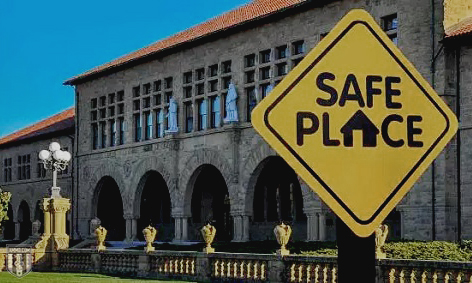
A similar concept is that of a “safe space.” What used to be a term
used for a place where people in actual danger of physical harm could
express themselves, a “safe space” now means a place where there is no
room for disagreement or questions because language is literally
violence.
This might all sound very silly and we definitely agree that it is.
However, it is quickly becoming de rigeur not just in academia, which is
increasingly functioning as a bizarre combination of a daycare center
for 21 year olds and an indoctrination program, but also in the
corporate world and in the media.
It’s not surprising that such foolishness has reached our corporate
elites, because so many figures within that world come from the Ivy
League. Harvard Law, for example, was the center of a controversy where they were urged not to teach rape law or even use the word “violate”
(which makes it pretty hard to talk about violations of the law). A
Harvard professor argued that greater anxiety among students to discuss
complicated and nuanced séxual assault cases was impeding the ability of
professors to adequately teach their students. This in turn would lead
to poorly prepared attorneys for rape victims in the future.
Beyond a simple discussion in the academic sphere, there are student
groups on campus who urge students not to attend or participate in class
discussions focused on séxual violence. The same student groups
advocate for warning students in advance so they can skip out on class
and even to exclude “triggering” material from tests. Once again, the
real victims here are the victims of séxual assault whose attorneys will
be ill-prepared to advise them, to say nothing of the cumulative effect
on the prosecutorial environment.
Northwestern University professor Laura Kipnis was subject to a lengthy investigation by a kangaroo court and frivolous Title IX complaints over an article she wrote for The Chronicle of Higher Education about campus séx panics. Top comedians like Chris Rock now refuse to perform on college campuses, a place that has typically been their bread and butter.
Another key term to understand here is “microaggressions”
which means just about anything. Offensive statements under this
umbrella include things like “I don’t see race,” “America is the land of
opportunity” and “I believe the most qualified person should get the
job.”
To readers of Generation X or older, this all might sound like a
resurgence of political correctness and, indeed, to some extent it is.
However, there is something different about the current anti-speech
craze sweeping not just campuses, but also boardrooms: Political
correctness was, at least in theory, about the elimination of so-called
“hate speech” (for example, using “mentally disabled” instead of
“retarded” or “little person” instead of “midget”) and also about
broadening the canon of literature to include more women and minorities.
One doesn’t need to agree with either objective or be as generous as
we are to see that the West has entered a new, accelerated and
intensified version of the old political correctness that is
qualitatively more dangerous. The “safe spaces” phase of this is about
eliminating anything and everything that might be emotionally troubling
to students on campus.
This assumes a high degree of fragility among American college students. But perhaps this assumption isn’t totally off base.
The Road to Safety Obsession
 If
you were born before 1985 or so, your childhood was vastly different
than of those born after you. As a child, you probably came and went as
you pleased, letting your parents know where you were going, who you
would be with and when you might be home. You rode your bike without a
helmet and if you were bullied at school there’s a good chance that you
view this as a character-building experience, not one of deep emotional
trauma.
If
you were born before 1985 or so, your childhood was vastly different
than of those born after you. As a child, you probably came and went as
you pleased, letting your parents know where you were going, who you
would be with and when you might be home. You rode your bike without a
helmet and if you were bullied at school there’s a good chance that you
view this as a character-building experience, not one of deep emotional
trauma.
So what happened?
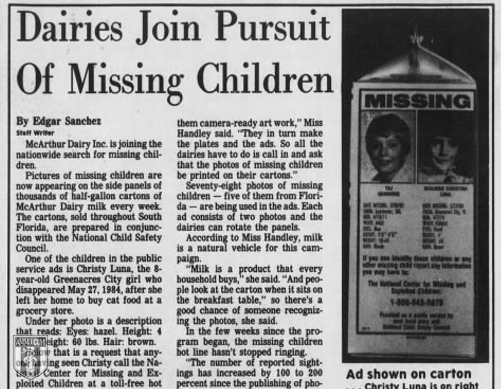
A few things. First, in 1984, the “missing child” milk carton
was introduced. America became obsessed with child abduction in
response to several high-profile child kidnappings over the period of a
few years. Etan Platz, Adam Walsh and Johnny Gosch
are just three of the names known to Americans during this time period.
In September 1984, the Des Moines, Iowa-based Anderson Erickson Dairy
began printing the pictures of Johnny Gosch and Eugene Martin on milk
cartons. Chicago followed suit, then the entire state of California. In
December 1984, a nationwide program was launched to keep the faces of
abducted children front and center in the American mind.
The milk cartons didn’t find many kids, but they did create the panic
of “stranger danger,” where children were taught to fear strangers even
though the lion’s share of child abduction, molestation and abuse comes
from friends, family and other trusted figures such as public school
teachers or camp counselors. Most
missing children in America are runaways and in 99 percent of all child
abductions, the perpetrator is a non-custodial father. There is at least one case of “stranger danger” being harmful – a lost 11-year-old Boy Scout who thought his rescuers were looking to kidnap him.
Some of the protocols established out of this were useful, such as AMBER Alerts and Code Adam.
Awareness of child abduction in general was raised and as a result
there’s significantly fewer child abductions today than there were in
1980. Indeed, stranger abduction is incredibly rare in the United States. But this has come with a dark side.
You might be familiar with the myriad of cases in suburban America where children playing alone are arrested by the police because they don’t have adult supervision. The parents are then questioned by the police or, in some cases, the state’s Child Protective Services.
There was also the panic after the mass shooting at Columbine High School, which led to the bubble wrapping of schools alongside the home. “Zero tolerance” policies were implemented alongside school-wide peanut butter bans.
And so the result is that there are at least two generations of
American children raised in a protective net so tight that they not only
have trouble expressing themselves, but also being exposed to failure and discomfort.
What began as a good-faith effort to prevent child abduction and
increase overall child welfare has ended up, as a side effect, creating a
world where children were raised in such safety that they can’t even
handle being upset.
This has not only insulated children from the consequences of their
own actions and the normal pains of growing up, but also gives the
impression that no matter what their problems, “adults” are ready to
step in and save the day at any moment.
It’s worth noting that, in recent years, there has been a sharp rise in mental illness among young people, both on campus and off, including those with severe mental health problems.
Cops and the 24-Hour News Cycle
 There are two other cultural phenomena worth exploring: The television series Cops and the 24-hour cable news cycle. As of April 2020, Cops is still on the air, having moved from Fox to Spike TV in 2013.
Cops was more than just a TV series, it was a cultural phenomenon that changed television. The cinéma vérité
style used by the show was to be copied in the 90s by virtually every
reality show you can name. Curiously, it came out around the same time
that crime rates had plummeted comparatively to the 70s and 80s. And
just at that time, people started having the worst in human behavior
beamed into their homes for entertainment every Saturday night.
At the same time, CNN was bringing news into your home 24 hours a day
without end. This meant they had to fill programming around the clock –
and most news is bad news. So in addition to a hugely popular program
centered around chasing criminals in the act, Americans also had a
constant stream of bad news and dangerous events pumped into their
homes. The result was the end of the “free range child,” the kind who
learned through play and discovered risk management through trial and
error. This was replaced with children whose entire existence was
micromanaged by adults, with little to no unsupervised play time.
The ability to learn through failure is a well-established principle going back to the Greeks, who called it pathemata mathemata (“guide
your learning through pain”). The knowledge and wisdom gained through
failure and pain are arguably more lasting and valuable than those
learned in school.
The Generation Gap: Millennials and Gen Z
Older generations (Generation X and Baby Boomers) have a tendency to
conflate Millennials and Gen Z (also known as “Zoomers”). However, there
are two key differences, one cultural and one clinical: First, Zoomers
are much more digital natives than their Millennial counterparts. They
didn’t get constant internet access or mobile access at college. They’ve
had it since they were in middle school in many cases.
While this is bound to create secondary cultural differences, we know
of one clinical difference between Millennials and Zoomers: Zoomers are much more prone to mental illness, specifically depression, anxiety, alcoholism and self-harm.
Depression and anxiety in particular are through the roof for girls, with moderate increases for boys. While self-reported cases are up, we also have harder clinical data: There has been a 62 percent increase in hospital admissions.
The Baby Boomers and Gen Xers created an environment where it is safer than ever to be a child,
but at what cost? There has been widespread and verifiable
psychological damage done to the younger generation, which is likely
being compounded by the coddling taking place in our nation’s
universities.
Screen Time and Social Media
“Screen time” is the new obsession for parents, especially among,
ironically, those who work in high-tech Silicon Valley jobs such as Steve Jobs, father of the iPhone.
But there seems to be an emerging consensus among those who have
actually studied the topic that the problem isn’t “screen time” per se,
but rather the more specific use of it in the form of social media. This has been identified as the cause of depression and anxiety, particularly among girls.
Why is social media usage particularly impactful among girls? Dr.
Haidt and others postulate that it’s because they are more sensitive to
the “perfect” lives being lived by beautiful social media influencers
– at least the lives that they lead online. What’s more, there is a lot
of exclusion and bullying taking place on social media. In days past,
you only heard about the party you didn’t get invited to, but now you
get to watch it unfold in real time on Snapchat or other platforms. And cyberbullying is much harder to track and police than its real world equivalent.
There’s a related bubble wrapping going on with regard to a different
sort of screen time: Kids today are often forbidden from playing with
plastic guns or even finger guns. There is the notorious case of the
7-year-old child who was suspended for biting a Pop Tart toaster pastry into the shape of a gun.
But millions of children come home (from the same schools where finger
guns can warrant a suspension) to play Grand Theft Auto for hours on
end.
Indeed, there is some evidence that suggests that violent movies and video games can trigger violent thoughts in some, but not all, people who view them. The National Institute of Mental Health has done an extensive study detailing the impact that violent media has on those who view it.
Read the rest here...


 60-year-old Bernell Trammell owned a small store in Milwaukee. He was kind man, well liked in his neighborhood, a religious man who did some street preaching. He was also a Trump supporter. That got him murdered.
  (reposted by request)