Showing posts with label obit. Show all posts

Friday, October 27, 2017

Fats Domino Makes The Passage

 http://blogs.escolaturbula.com/music-across-europe/files/2010/11/fats1.jpg

Antoine 'Fats' Domino passed away last night in New Orleans, of natural causes. He was 89.

Back in the 1950's and early 1960's he fused N'awlins R&B with white pop and early rock n' roll memes to create a unique style that opened the door for a whole lot of acts from New Orleans. You can hear it in huge hits like 'Blueberry Hill,' 'Ain't That A Shame,' "Blue Monday' and one of my faves, 'Walking To New Orleans.'

At one time, he was a huge star, but he apparently succumbed to something that seems to hit a lot of musicians from New Orleans...a feeling that he was more comfortable just being a big name at home, in New Orleans, and was happy with that. Oh, there were bookings in places like Vegas now and then, but basically Fats stayed home with his family.

I met him briefly once when I got backstage at the Jazz and Heritage Festival back in the early 80's after his set, which the audience responded to the way you greet a beloved friend you haven't seen in awhile. And offstage, he was pretty much like his public image...friendly,courteous and relaxed. I remember thinking that he was one of the happiest people in the business I had ever seen, just totally comfortable with it all.

There was another time I was supposed to see him play, at Tipitina's, but he never showed...pity, because it was an amazing night with Professor Longhair and some of the Meters falling by. He would have fit right in beautifully. He always did.

 Image result for What years did Fats domino play at the Jazz and heritage festival

In 2005, after Katrina hit, he came back out of retirement at 77, for one final album, “Alive and Kicking,” to benefit New Orleans musicians who were affected by the hurricane. His voice wasn't what it once was, but he could still play great, and it's well worth a listen if you can find it.

Rest in peace, Fat Man...and thanks for the music.

Sunday, March 19, 2017

Chuck Berry Makes The Passage…1926-2017


Dammitt. Chuck Berry just passed away at 90 years of age 'after 'an illness' as the press likes to put it. Once he finally stopped performing about 5 or 6 years ago, I figured it wouldn't be too much longer.

That legendary vitality of his finally wore down.

Almost all of the old rockn'rollers have passed on to that Great Concert in the Sky, and when they're gone something unique will have gone with them.There's always was an ageless quality to Berry, something about that old spine and leg catharsis that still seemed young, powerful and ageless. Jerry Lee has it too and now in his eighties, he's pretty much just what he always said he'd be...the last man standing.

Two personal memories of Chuck Berry...two sides of the same coin.

A hot, humid summer night on the road, checking into a hotel in the Midwest, the name and exact place lost in the memory banks. Not a roach hole or a five star, but the sort of moderately priced place you stay at if you're on tour and trying to keep the costs down.

And who should I see checking out and headed towards the door with a guitar case and a small, black, travel bag in hand but Chuck Berry.

I'd seem his show a few times, so I walked over, ascertained that it really was him, and introduced myself politely. I told him what band I was playing with and made a remark about how much I loved his music. The response? "Thanks, kid" and then out the door..no smile, no chit chat, no handshake, no nuthin'. It was as if I had insulted him somehow, it was that detached and frigid.
I shrugged, and went back to the hotel desk.

Take two...a night at the Aquarius theater in Hollywood, at a filming of the old TV show, 'In Concert'. I was there courtesy of a backstage pass from the manager of one of the eminently forgettable bands set to be filmed that night, some of them with actual records on the radio.

Loads of roadies and plenty of heavy duty equipment. Marshall stacks, huge drumsets, big hair, flashpots and pyrotechnics, nubile young ladies checking out the bulges in the spandex, a slight smell of marijuana in the air, schmoozing and those little white lines laid out backstage...a typical concert scene for the times.

One by one, the bands came on, did their shtick, and they all got a nice, enthusiastic response from the crowd.

And then out walked a fifty-ish Chuck Berry...one small Fender Twin amp, one guitar, and just like always, an obvious pickup band consisting of a bass player and a drummer, probably hired for scale from the local union for that night's show.

What happened next was sheer magic.

Chuck checked his tuning..and then he did one of those metallic signature intros to 'Johnny B. Goode', and the left foot came down.

Within ten minutes, he had the whole theater shaking, literally.

Most of that night's audience were probably still in diapers or not even born when most of the songs he played that night first came out. And I'd bet a lot of them didn't even know who he was. But there was something magically seminal about it that just connected, something dangerous, sexy and energizing that settled over the audience like a cloud.

Security tried to keep people from crowding the area in front of the stage and dancing in the aisles, but it was a losing battle and they just gave up after awhile. And me, I just stood in the wings, watched, listened and marveled.

This was the true, anarchistic spirit of rock 'n roll unleashed and it didn't sound like an oldies show in the least..it sounded new, wild and untamed, and I could catch a glimpse of how it must have hit the teenyboppers at places like the old Brooklyn Paramount right between the eyes back when Chuck, Jerry Lee, Buddy and Elvis laid it on them in the fifties.

One guy, a guitar, an amp and a two man rhythm section. It was perfect. The original Brown Eyed Handsome Man en extremis. I can only imagine what he was like in the 1950's.

He finished and  walked right by me and I just nodded and smiled. He kind of jerked his head at me in acknowledgement, but I learn quick, so I wasn't about to say anything more.

The band that appeared after Chuck Berry finished with that crowd looked positively tired and ill by comparison. They just seemed glad to just get the whole ordeal over with. A real, actual case of the rockin' pneumonia and the boogie woogie flu perhaps, and I betcha it wasn't the first time Chuck Berry gave that particular version of the disease to somebody scheduled to follow him on stage.

I have a soundboard tape of what went down that night, and it's one of the things I still crank up and listen to when I want to remember what real live rockn'roll sounds like.

So long, Chuck. Rest in Peace, and thanks for the music.

Wednesday, September 28, 2016

Shimon Peres, 1923-2016

 Shimon Peres in Brazil (cropped 2).jpg
 (By Elza Fiúza - Agência Brasil (Department of Press and Media).  Courtesy of WikiCommons)

Shimon Peres, one of the original founding fathers of Israel died yesterday at 93 after a massive stroke. For many Israelis, he was the final link between the founders who created the miracle of Israel and the present day.

There's a lot that could be said about Shimon Peres. He was a key aide of Ben-Gurion's and played a major part in wheeling and dealing to get the Haganah arms during Israel's War of Independence in1948, when the world, after recognizing Israel as a state pretty much turned their back on the Jews in the face of Arab jihad less than three years after Auschwitz was liberated. While the Arabs received modern arms and in the case of Jordan, trained officers from Britain to lead to lead the Arabs in their planned annihilation of the Jews of Israel, most nations placed an arms embargo on the nascent Jewish State in the name of 'neutrality' including the United States.

Peres found enough ways around that (with the assistance of a number of sympathetic souls around the globe, some of whose names would surprise you) to get enough arms and ammo into Israel so that with G-d's help Israel survived.

It's never ceased to amuse me that the first major shipment of arms to Israel were Nazi arms manufactured in Czechoslovakia that Peres bought on the black market.

There is plenty more you can read elsewhere about his career. A socialist kibbutznik (he helped found Kibbutz Alumot) he remained a man of the left his entire life. He served time in Israel's government as defense minister, where he was instrumental in establishing close relations with France that led to massive arms deals to help Israel keep its edge over the enemies that surrounded it. The French thought so highly of Peres that they awarded him the Legion D' Honor.

He served as Prime Minister twice, but was never actually elected, leading to one of those wonderfully acerbic Israeli political jokes I needn't mention here. Eventually, he served as Israel's President, a largely ceremonial role that he performed with distinction.

Yes, there are other things that could be said about Shimon Peres that aren't so complimentary, and I think a lot of Israelis know exactly what I'm talking about.

But this isn't the time or place for that, not today. Today, we honor one of Israel's pioneers, a man who helped create a nation for the Jewish People.

Rest in peace Shimon (Z"L). And may your memory be blessed for the good you accomplished.

Sunday, March 13, 2016

Keith Emerson, 1944-2016

Keith Emerson of Emerson Lake and Palmer prog rock 1970's

Keith Emerson, one of the great keyboardists and showmen of rock n' roll was found dead today in his Santa Monica California home. He was 71.

Half Jerry Lee Lewis and half Van Cliburn, Keith Emerson started out in England as a classical pianist who later got interested in jazz, rock and the Hammond organ. He first hit the big time in the 1970's with Emerson,Lake and Palmer, a band he formed with singer, bassist and guitarist Greg Lake from King Crimson and drummer Carl Palmer. The band's original albums mixed classical memes with pop and rock influences and synth hooks. They even had the chops to pull off their own version of Mussorgsky's 'Pictures At An Exhibition' - and issue it as a live album! I'm sure Mussorgsky, something of a rocker himself would have absolutely loved it.


Watching Emerson onstage was amazing. He pioneered the use of synthesizers in live rock n'roll back in the days before preset patches, so it all had to be done by hand on the fly in front of an audience, and the switchboards themselves looked like space age consoles. I can't imagine how he pulled it off. Aside from his amazing playing, he was known for doing to a Hammond (usually the Smaller A models, not the B-3's) what Jimi Hendrix used to do to a Strat. He'd knock it around, throw it on its side, rock it back and forth to make to oscillators scream and even used to stick a knife in the keyboard so one note would sustain as a drone while he played the other notes on the keyboard.

I saw the band 3 times, and one of my favorite concerts of all time was a show they did at the relatively small Anaheim Convention Center to promote their hit album 'Brain Salad Surgery'...in quad, believe it or not, with speaker stacks in all four corners of the hall and the incredible sounds they were making whizzing around the hall.

They called it a day in 1979, and since I was just getting started in the biz around the time they pulled the plug, I never ran into Keith Emerson although I would have loved to. A superb musician and by all accounts a pretty nice guy.

RIP Keith. And thanks so much for the music.

Monday, February 15, 2016

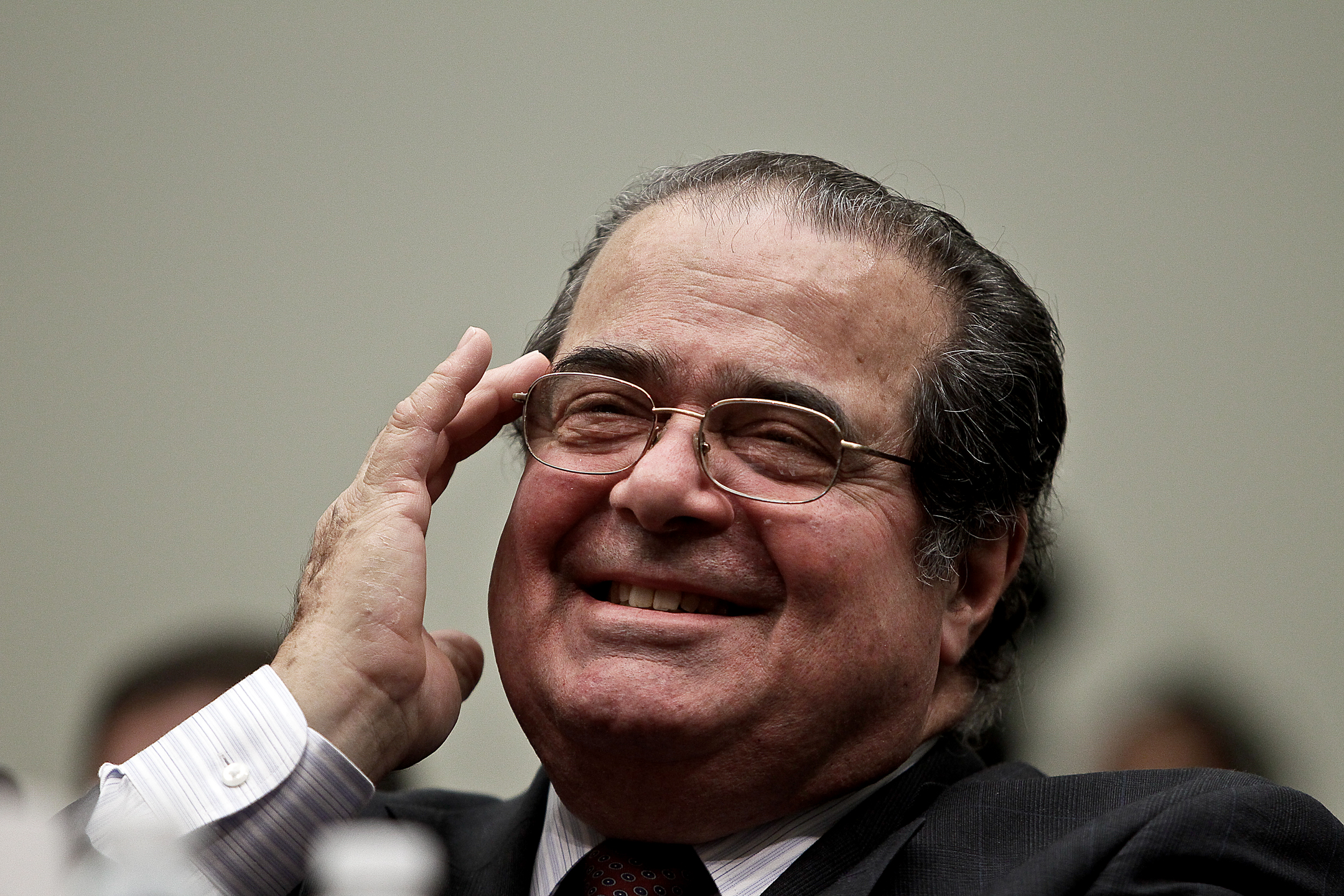
Justice Antonin Scalia..RIP

https://upload.wikimedia.org/wikipedia/commons/5/5a/Antonin_Scalia_2010.jpg

Supreme Court Justice Antonin Scalia was found dead at an isolated Texas Ranch where he had gone for a conference, Cibolo Creek Creek Ranch in Marfa,Texas. He was 79 years old.

The cause of death is still unknown,although it is known that it wasn't a heart attack. Another odd factor is that he was found lying in bed with a pillow over his face. And for some reason, according to the AP, an autopsy was not deemed necessary.

Justice Scalia was a personal favorite of mine, someone for whom the Constitution meant what it said and whose opinions were not only scholarly but laced with a wicked, thoroughly entertaining wit. One of his best friends on the Court was none other that Ruth Bader Ginsberg, with whom he often attended the opera they both loved.

I'm sorry, and I hope events prove me wrong but this appears to have all the earmarks of a hit. While it remains to be seen if President Barack Hussein Obama will be able to shove another leftist ideologue on the Court, the more important aspect of this is how convenient it is for ginning up Democrat turnout and fundraising because 'the Supreme Court's at stake!'

Yes, it always was, but this puts a spotlight on it. The next president will likely be able to nominate 3-4 justices and the difference between whom Hillary Clinton or Bernie Sanders would pick versus Ted Cruz or Donald Trump is simply night and day.

There actually is a precedent for not nominating justices in a presidential election year. Even the Democrats agreed on that one when it was convenient for them. they should be held to it.

And GOP Senate Majority leader Mitch McConnel has made it plain that Scalia's replacement will be named by the next president. The senate actually has the means to do that, but we'll see how much spine McConnell has. Needless to say, anyone whom caves on this deserves harsh consequences.

Stay Tuned...

Monday, December 28, 2015

So Long, Lemmy...Rockin' Until The End

http://media2.s-nbcnews.com/j/newscms/2015_53/1356351/151227-lemmy-kilmister_057ab1398b7a662500da1086da57b214.nbcnews-ux-2880-1000.jpg

Bassist, singer and catalyst Lemmy Kilmister has made the Passage, at age 70 from cancer. Considering the other stuff he survived, well...

Lemmy stated out as the bass player for the old British trance/sci fi rock band Hawkwind, and after leaving or being fired depending on whom you talk to, went on to form one of the original proto-metal bands, Motörhead in 1975. They stuck around for twenty two albums and remained a favorite on the touring circuit. Playing was pretty much his life, and I can't help but think that's how he wanted to go out. Here he is earlier this year at Rock am Ring, playing 'Overkill.'


So long and rest in peace, Lemmy. You were definitely one of a kind.

Friday, May 15, 2015

BB King Makes The Passage 1925-2015

https://shawglobalnews.files.wordpress.com/2014/04/bbking.jpg?w=720&h=468&crop=1

BB King, that icon of blues and R&B has gone to the Lord, at the age of 89.

The news isn't unexpected, since he had diabetes and was in poor health generally. According to his lawyer, Brent Bryson, BB King went peacefully, dying in his sleep at his home in Las Vegas.

BB King was more than just an incredible guitar player and singer. During his career, which went back to the 1950's, his amazing performances influenced virtually anyone who played guitar. Eric Clapton, Jimmy Page, Mike Bloomfield, Robbie Robertson, Elvin Bishop, Mick Taylor, Billy Gibbons, Peter Green,Stevie Ray Vaughn and Robert Cray were just a few of the musicians whom he inspired and in some cases mentored. To say he changed the face of music is to state the simple truth.


Riley B. King grew up in the Mississippi Delta, on a cotton plantation near Indianola, Mississippi in the Roaring Twenties, the time of the Great Flood and the black migration from the south to the north and west. There, he heard the sounds of people like Robert Johnson, Peetie Wheatstraw and his cousin Bukka White, music he later integrated with his gospel singing roots into his own unique sound. At the age of 23, he was appearing on Sonny Boy Williamson's King Biscuit Flower Hour on KWEM in Arkansas, a show that could be heard all over the South and even as far north as Canada if you were lucky.

 http://www.achievement.org/achievers/kin2/large/kin2-014.jpg

Later, BB went across the river to Memphis, the northern corner of the Delta where he got himself a spot performing and deejaying on WDIA. That's where he discovered the electric guitar courtesy of T-Bone Walker who was a guest on BB King's radio show.

A couple of years later he was recording for the Bihari Brothers' L.A. based label, with most of his tracks being produced by none other than Sam Phillips, who also recorded a number of other bluesmen like Howlin' Wolf, Pat Hare and Ike Turner, and later went on to form Sun Records...where one day, a skinny, black-haired white teenager with the unusual name 'Elvis' walked through the door.

 http://img.www3.hp-ez.com/img/2616/tumblr_lkd92j5BBd1qabj53o1_500%5B1%5D.jpg

BB King was a regular on what was then called the 'chitlin' circuit - small to medium sized black clubs and social halls - ever since his first real hit, "Three O'clock Blues" in 1952. He was young enough to be able to deal with the extended touring involved and in the right place at the right time to take advantage of the revolution electric instruments and amplification brought to popular music.

It was around this time BB switched his guitar permanently from Fenders to various models of Gibson's ES ('electric Spanish' ) semi-hollow bodied guitars. The one below is, I believe,  an ES-345 SV with stereo wiring or an ES-335, the non-stereo version. Both utilize a Varitone, a switch to change the mid-range and treble on the guitar for different tones.

 http://upload.wikimedia.org/wikipedia/commons/6/67/B.B._King_3011710047.jpg

 B King always called his guitars 'Lucille, ' a reminder of an incident on the chitlin' circuit where two men got into a fight over a woman named Lucille. One of them knocked over a lamp and set the club on fire, and BB ran back into the blazing club to retrieve his guitar. He called all of his guitars Lucille ever after.


BB King's real break came in the sixties, when the rock and roll guitar idols began mentioning his name in interviews as an influence, The Rolling Stones took him on tour with them in 1969 and he had a major 1970 crossover hit, "The Thrill is Gone" and a TV appearance on Ed Sullivan that brought him into the mainstream. Here's a fragment:


Just as he had for decades, BB continued to do his 300+ shows a year, slowing down only a little as age and illness crept up on him.

I ran into him three times, once on the road, once backstage after an incredible show with Bobby Blue Bland and Albert King, and once at his night club in Los Angeles. He was always gracious and friendly well beyond the usual show biz norm once he had sussed you out and realized you just wanted to say hell or, talk music or guitars and weren't trying to put the arm on him for something.

BB King went off peacefully, thank G-d, and his music will live forever.

We've lost quite a few wonderful musicians lately, and when someone like BB King leaves the building, it breaks a chain that goes all the way back to the Delta where it all started.That is a very grievous loss, because in many ways, music is sort of a conversation between musicians, which is how it grows and changes.  BB King was a huge contributor to that conversation. and sadly,  there aren't many new ones coming along whom are part of it,  whom are connected to that tradition, or have the talent to keep the flame kindled even if they were.

And that loss saddens me no end.

Monday, March 17, 2014

In Memorium: Rabbi Abraham Avrech June 4, 1919 — March 15, 2014

Chaplain Avrech leads Jewish services during the Korean war. I once asked my father of what he was most proud during his service in the Army. He told me that once he led Protestant services because there was no Christian Chaplain available. “I performed a real mitzvah,” he said.

I was saddened over the weekend to hear that the father of my friend Robert Avrech over at Seraphic Secret passed away on the Sabbath, at the age of ninety four. The above photo is of Rabbi Avrech performing services for Jewish soldiers during the Korean War, and is from Robert's personal collection.

Rabbi Abraham Avrech (Z"L) lived an amazing, full and G-dly life, and Robert has written a moving memorium to him here.

I recommend you read it, to pay tribute to a good man who embodied life's potential and possibilities.


Baruch Dayan Emet...Blessed Be The True Judge.


Monday, February 03, 2014

Barry Rubin Z'L - A Strong Voice For Israel Passes On

 http://www.jpost.com/HttpHandlers/ShowImage.ashx?id=235435&h=236&w=370

I'm tremendously saddened to report that Professor Barry Rubin passed away at the age of 64 after a long battle with cancer today in Tel Aviv.

He was an important, eloquent and prolific scholar of Middle East affairs and history as well as a strong voice for Israel.

As a director of the Global Research in International Affairs (GLORIA) Center at the Interdisciplinary Center Herzliya, as a long time columnist for the Jerusalem Post and Pajamas Media, the editor of the Middle East Review of International Affairs (MERIA) Journal, and editor of the Turkish Studies Journal as well as a prolific author, his voice was always a must read for any understanding of what was going on in the Middle East.

Born in the United States, Professor Rubin, was a former Fulbright and Council on Foreign Relations fellow, received his Ph.D from Georgetown University in 1978 and taught at both Israeli and American Universities.

He was under no illusions about the rise of Islamist fascism or the West's being in denial about its danger, or the need for Israel to take steps to defend itself.

His discourse, especially with his peers was always the epitome of politeness and reasonableness while still maintaining the edge of his considerable knowledge and scholarship, and in spite of his busy schedule, he always seemed to make time to answer an e-mail or a question or indulge other writers who sought his opinions.

He had an amazing ability to analyze what was going on and put the pieces together in perspective, and you could always count of his prolific and insightful writing to illuminate the dark corners.

A good sample of his work can be found here at his blog, The Rubin Reports.

I will miss his insight and clarity tremendously, as will the world.

Professor Barry Rubin is survived by his wife Judith Colp Rubin and their two children. My heart and condolences go out to them.

Tuesday, January 28, 2014

Obama's Loving Requiem For A Prominent Communist - And Mine

 http://msnbcmedia.msn.com/j/msnbc/Components/Photos/060516/060516_seeger_vmed_2p.widec.jpg

The mask is coming off, even if it never covered much to begin with.

Pete Seeger is dead today, at 94. And this is what our Dear Leader had to say about it:

"Once called “America’s tuning fork,” Pete Seeger believed deeply in the power of song. But more importantly, he believed in the power of community – to stand up for what’s right, speak out against what’s wrong, and move this country closer to the America he knew we could be. Over the years, Pete used his voice – and his hammer – to strike blows for worker’s rights and civil rights; world peace and environmental conservation. And he always invited us to sing along. For reminding us where we come from and showing us where we need to go, we will always be grateful to Pete Seeger. Michelle and I send our thoughts and prayers to Pete’s family and all those who loved him."

Now, aside from being someone who made quite a contribution to American music, Pete Seeger was also a hard core communist and apologist for Stalin during the time when 'Uncle Joe' murdered over 100 million people. The forced collectivization, the murder of political opponents, the show trials, the forced famine in the Ukraine that murdered at least 3 million people, the gulags...none of it mattered at all to Pete Seeger, that 'champion of justice and freedom'.

By his own admission, he was a red diaper baby, someone who was brought into the party by his parents and raised under what the Comintern called Party Discipline. That meant you followed the orders of the Kremlin, no questions asked. And that's exactly what Pete Seeger did. He claimed that he 'drifted out of the party in the 1950's', but he never once lifted his voice to oppose Soviet tyranny until the game was almost over, in 1982 when he made statements in favor of Poland's Solidarity movement.

After the 1939 Hitler-Stalin pact, there were some commies who woke up to what that meant and left the Party. But not Pete Seeger! Whatever Hitler was doing to the Jews was no never mind to him. As a member of the Almanac singers (later called the Weavers) with a fellow party member, Woody Guthrie, he totally followed the Moscow line, calling for America to stay out of WWII...here's a sample lyric: "Franklin D., listen to me,/You ain’t a-gonna send me ’cross the sea.”

He and his fellow Party members lobbied aggressively against aid to Britain, American re-armament and against FDR's selective service act, which passed in 1940 by one vote. If it hadn't, things would have been very different after Pearl Harbor. The Almanac's 78 recording, Songs for John Doe was so subversive even Eleanor Roosevelt, a fan of the group, denounced it.

That changed abruptly in June, 1940, when Hitler invaded Russia. Then, Seeger and his friends started singing a brand new tune, urging America to get into the war and save Stalin's posterior. In a true 1984-style example of revisionism, Seeger and his pals had all the available copies of Songs for John Doe recalled and destroyed...although enough copies remained in a few people's hands so that we can see exactly how hypocritical, radical and anti-American these people were.

After the war, Seeger remained active in shilling for Stalin and his successors. He was one of the leaders calling for clemency for the Rosenbergs, the spies who gave Stalin the atom bomb. Yes, the great world peace advocate had no problem with a homicidal maniac and mass murderer like Stalin getting the bomb.

In 1945, Seeger put together something called People's Songs, Inc, an organization designed to “create, promote and distribute songs of labor and the American People.”

Here's what the California Senate fact finding committee had to say about it:

"People's Songs is a vital Communist front … one which has spawned a horde of lesser fronts in the fields of music, stage entertainment, choral singing, folk dancing, recording, radio transcriptions and similar fields. It especially is important to Communist proselytizing and propaganda work because of its emphasis on appeal to youth, and because of its organization and technique to provide entertainment for organizations and groups as a smooth opening wedge for Marxist-Leninist-Stalinist propaganda."

Seeger was actually subpoenaed by the House Un-American Activities Committee in 1955, but refused to answer questions about his communist past and eventually refused to answer subpoenas. He was actually tried and convicted of contempt of Congress, but his conviction was overturned over a technicality.

Along with his commendable support for civil rights for blacks in America, Seeger continued to be a shill for the Soviets and ultra-Left causes throughout the years.

He was a big advocate of unilateral disarmament by the West, including the Soviet's phony International Peace Petition. In spite of his image as a champion of freedom, he had nothing to say about the Soviet repression of democratic revolutions in Hungary in 1956, or in Czechoslovakia in 1968. And of course, he was a supporter of Fidel Castro and his executioner, Che Guevara.

He was predictably against the Vietnam War, but had nothing to say about the North Vietnamese gulags and fascist repression after the war, or Pol Pot and the Khmer Rouge's Killing Fields in Cambodia.

He opposed President Reagan's rearmament of the West after the Carter years, and was huge advocate of he Nuclear Freeze Movement of the 1980s, a Soviet-sponsored initiative that would have frozen Soviet nuclear and military superiority in place and stopped Reagan from defeating the Evil Empire.

In 1999, along with Ed Asner and fellow communist Ossie Davis, Seeger was on the advisory board of Mumia 911, a group that championed cop-killer Mumia Abu Jamal, AKA Wesley Cook.

Jamal, a Black Panther murdered police officer Daniel Faulkner in 1981 execution style during a routine traffic stop, according to three eyewitnesses. Two policemen and one hospital security guard testified to the court that while Mumia Abu Jamal was being brought into the hospital following the altercation with Faulkner, he shouted repeatedly, “I shot the mother f---er, and I hope the mother f---er dies.” He was unanimously convicted by a racially mixed jury. Faulkner left behind a wife and three young children.

Seeger and Mumia 911 were part of an ultra-Left chorus agitating for his freedom, along with another communist front, the National Lawyer's Guild.They wanted him freed, and thanks to their efforts Mumia's death sentence was commuted to life imprisonment. Unlike Faulkner, Mumia Abu Jamal had a high profile cheering section that included a number of celebrities including Seeger, and they had just enough clout to keep him alive when by all rights he should have been executed for murder.

In 2000, Seeger found another murderous dictator he could support, Saddam Hussein. He was a signatory to a New York Times ad that called for an immediate end to U.S. economic sanctions against Saddam's regime, charging America with “killing … over one million Iraqis, mostly children under five.” Fellow signers included Rosie O’Donnell, the Berrigan brothers, Ed Asner, Rev. James Lawson, Tim Robbins, Susan Sarandon, Martin Sheen, Ramsey Clark, Howard Zinn, and Noam Chomsky, among other prominent Leftists.

Even 9/11 didn't make this man stop and think about the filth he was encased in. In 2003, he signed on to to a “Statement of Conscience” crafted by Not In Our Name, a front group of the Revolutionary Communist Party that condemned the Bush administration’s “stark new measures of repression,” and any semblance of trying to defend America against Islamist fascism.

And as you can imagine, Seeger had a soft spot for the Occupy crowd too. On October 21, 2011, Pete Seeger was part of a solidarity march with Occupy Wall Street to Columbus Circle in New York City.

No wonder President Obama was so in love with him.I'm surprised the president didn't hang a Medal of Freedom around his neck.

So now, he's passed on.

Since President Obama has already posted his tribute to the man, I suppose I should post mine.

Pete Seeger was a lifelong advocate of evil, whatever he might have thought of it if he even bothered to think. He used his considerable talents to promote it and influence people to support it during his entire life. He saw what he wanted to see and ignored what was inconvenient. He mouthed support for 'freedom', but was himself a force for repression and slavery.

He advocated for civil rights for black Americans, but was at the same time a prominent and consistent advocate and apologist for those who sought to deny civil rights for others, in many cases even the right to life itself. He was a champion of injustice and human misery. He never murdered anyone, but just as there were a lot of Nazis who never shoved a Jew into the ovens, his voice was a major part of the foul chorus raised in praise and support for those that murdered millions.Like Leni Riefenstahl, he's proof that talent and artistry do not necessarily make an admirable human being.

In sum, he was a hypocrite whose actions supported everything he claimed to be against.

Rest in peace...perhaps. But I have a feeling that when Pete Seeger goes to his eternal reward, some hard questions are going to be asked. And before that particular court, unlike the 1950's, he's going to have to answer.

Saturday, December 07, 2013

The Mixed Legacy Of Nelson Mandela

 http://msnbcmedia.msn.com/j/MSNBC/Components/Slideshows/_production/_archive/News/_International%20News/Africa/ss-090717-Nelson-Mandela-NEW/ss-120601-mandela-tease.photoblog600.jpg

Former South African leader Nelson Mandela has passed away at the age of 95, from complications resulting from a lung infection.

Since he was essentially a secular saint, the hagiographies, the emotional tributes and the kicky sound bites will be in abundance. His place in history is assured, because like other secular saints, burning incense and making offerings at his altar is seen to confer virtue on the worshiper, especially if they're white.

Nelson Mandela was an important figure in contemporary history, no doubt. But who was Nelson Mandela really? What did he accomplish? What is his legacy?

That's a more complicated and nuanced story that you're unlikely to hear about much in the medias frenzy over the next week or so. Because it doesn't quite fit the script for a secular saint. And the complexity can be imagined when you learn that Mandela was the proud recipient of both the U.S. Medal of Freedom awarded to him by President Obama and the Order of Lenin, given to him by the Soviet Union, hardly a bastion of freedom or even simple human decency.


Certainly, he looked and sounded like a secular saint. A member of a family of Xhosa royalty, his tall, dignified bearing and his measured speech could almost have been cooked up by a Hollywood casting agent.

Nelson Mandela was born in Mvezo, a small village in the eastern part of South Africa's cape province. Coming from a prominent family , he received excellent schooling in South Africa's best schools so he could work as a councilor for the the Xhosa's Thembu royal house. He later attended University of Fort Hare, an elite black institution in Alice, Eastern Cape. There he first got his political indoctrination in anti-colonialism and his introduction to Marxism. Traveling to Johannesburg in 1941, he first ran into the African National Congress in the person of Walter Sisulu, then a member of the fledgling African National Congress (ANC) and the Communist Party of South Africa (CPSA). In Johannesburg, Mandela was taken under the wing of Lazar Sidelsky, a Left wing Jewish lawyer sympathetic to the ANC and a partner in the law firm of Witkin, Sidelsky and Eidelman, who gave Nelson Mandela a job as a law clerk.

In those days,the ANC was essentially a non-violent social justice movement that lobbied for black rights and engaged in local politics. However, like many similar organizations in the West, it had been targeted by the Soviet Comintern and was already infiltrated by members of the CPSA as well as by actual Soviet agents.

While the evidence is mixed over whether Nelson Mandela ever joined the communist party, he frequently attended their meetings, and many of his closest associates, like Lionel 'Rusty' Bernstein, Joe Slovo, the long-time leader of the CPSA, his wife Ruth First, Gaur Redebe, Walter Sisulu and Nat Bregman definitely were, and some of them might have been actual Soviet agents. All of them were under 'party discipline just as American communists were, which meant that their marching orders came directly from the Comintern and the Kremlin, no deviations allowed. Many members of CPSA became part of the ANC and the CPSA is still a part of the ANC's political coalition today. Mandela's openly expressed admiration and later friendship for communist dictators, his views on nationalization of South Africa's major industries and government redistribution of wealth and his subsequently receiving the Order of Lenin from the Soviets shows that at best, he was a communist sympathizer.

After South Africa's 1948 general election, the Afrikaner-led Herenigde Nasionale Party took power, uniting with the Afrikaner Party to form the National Party. They implemented the system of racial segregation known as apartheid. Mandela and his supporters were able to depose the existing ANC President Alfred Bitini Xuma at that time, who favored non-violence in seeking black civil rights and was an open anti-Communist. As Mandela wrote later in his memoirs, "We had now guided the ANC to a more radical and revolutionary path."

In 1955, Mandela finally went fully over to the idea of using terrorism as as a political tool, or as he put it, the ANC "had no alternative to armed and violent resistance. " In this, he was greatly influenced by his open admiration of the tactics of Mao Tse Tung and Fidel Castro.

In fact, the first 'revolutionary' act of Mandela's was to send communist party apparatchnik and ANC member Walter Sisulu to the People's Republic of China to obtain weapons. The PRC turned Mandela down, officially because they felt the ANC was not prepared for Mao-style guerilla warfare, but perhaps more likely because they were already deeply involved in arming and training the Viet Minh in their attempt to overthrow the Diem government in South Vietnam and similar operations with groups like the Pathet Lao elsewhere in South East Asia. They also likely underestimated Mandela and the ANC's ability to win a war where resupply would be so difficult and no communist-controlled havens were nearby.

However, Mandela and the ANC began to collect whatever weapons and explosives they could get hold of and prepare for armed struggle on their own,while continuing to work on political agitation against the apartheid regime.

It was at this time that Mandela, inspired by Castro's guerilla groups like 26th of July Movement and the Viet Minh founded his own terrorist elite, Umkhonto we Sizwe ("Spear of the Nation", abbreviated as MK) with communists Walter Sisulu and Joe Slovo. The MK made their debut with 57 bombings on Dingane's Day (16 December) 1961, followed by further attacks on New Year's Eve.MK killed civilians and military alike, and two of their more famous operations were the Church Street bombing and the Magoo's Bar bombing, both of which targeted civilians and were designed for maximum carnage..

The MK and an ANC group run by Mandela's wife Winnie called the "Mandela United Football Club" were also responsible for the murder, torture and kidnapping of both whites and black political opponents and their families who opposed 'armed struggle'. Much of this came out through Mandela's own Truth and Reconciliation Commission, which investigated crimes committed under apartheid by both the government and the ANC. The 1998 findings of that investigation were suppressed by President Mandela.

Winnie Mandela is credited with introducing the practice of using necklacing, forcing a gas or oil soaked tire over the head and shoulders to pin the arms of the victim and then lighting it on fire.Her quote? "With our matches and our necklaces we will liberate this country." She has never served a day in jail, and still sits on the ANC executive committee.

It's worth recalling that the ANC was officially named a terrorist group by the U.S. State Department and many other western nations. That designation wasn't rescinded officially by the State Department until 1990.

Mandela was arrested in August of 1962, charged this time with inciting strikes and violence and leaving the country illegally.The police subsequently uncovered paperwork in 1963 that documented MK's terrorist activities, some of which directly implicated Mandela.

These new charges were brought as well, and Nelson Mandela and two co-conspirators - all three of whom ultimately admitted being involved in terrorism - were sentenced to life imprisonment in June of 1964, for 23 specific acts of sabotage and attempting to overthrow the government.

Mandela was sent to Robben Island, where he would essentially rot for the next 18 years,until 1982. The personal courage he showed during this time is undeniable. He spent his time in an 8x7' concrete cell with a straw mat to sleep on, some of it in isolation. He endured physical abuse by his jailers and hard labor, first breaking rocks into gravel and then quarrying lime.

Through it all, he somehow kept his spirits up, helping to form classes with the other prisoners on various topics.

In 1982, Madela's circumstances changed, when he was moved to a much more pleasant jail, Pollsmoor Prison, where he stayed between 1982-1988. He was allowed relative freedom,indulged in gardening and was able to take classes to complete his LLB degree.


Outside Pollsmoor, things were changing.

While the Soviet gulags and the enslavement of Eastern Europe,the communist run killing fields in Cambodia, terrorism at home and abroad against Israel and Fidel Castro's concentration camps on the Isle of Pines scarcely merited any attention, South Africa's apartheid became a major cause celebre'. And with it, 'Free Mandela!' became a rallying cry.

Violence in South Africa escalated, both between whites and black and along tribal lines. The ANC 's portion included an attempted attack on South Africa's Koeberg nuclear power plant near Cape Town in 1982, which would have incurred horrendous casualties among both blacks and whites and an environmental catastrophe if it had been successful. It very nearly was.

The violence was also deliberately orchestrated by the ANC to sabotage reforms to apartheid that then President P.W. 'Pik' Botha was trying to initiate, which permitted some non-whites to vote and to elect their own parliaments to control education, health, and housing.

Believe it or not, it was Margaret Thatcher who first suggested to Botha that he free Mandela as a gesture towards peace and to reduce international tension. In February 1985 Botha did exactly that, offered Nelson Mandela a release from prison provided he "unconditionally rejected violence as a political weapon".

Mandela turned him down, partly out of the principle that he would not negotiate anything while the ANC was banned, but mostly because accepting Botha's offer would have ended Mandela's credibility with the more hardline factions of the ANC, a problem that would recur later. So the killing went on, with the ANC committing 231 terrorist attacks in 1986 and 235 in 1987.

South African Minister of Justice Kobie Coetsee made another try at negotiations, setting up talks between Mandela and the Botha government starting in May 1988. Mandela was again offered his freedom, the government agreed to the release of political prisoners and the ANC provided that they permanently renounce violence, break links with the Communist Party and agree to negotiate a fair political settlement. Mandela refused.

Nelson Mandela's 70th birthday in 1988 was made a sort of international jamboree, including a gala 'Nelson Mandela 70th Birthday Tribute' concert at London's Wembley Stadium. He was subsequently moved to Victor Verster Prison, another relatively comfortable facility where he spent time in the prison hospital recovering from tuberculosis.

In 1989, Botha suffered a stroke and F. W. de Klerk took over as president. De Klerk realized that apartheid was unsustainable and took what amounted to giant steps to make the transition in the face of strident opposition from his own party. He unconditionally released all ANC prisoners except Mandela, and after several talks with Mandela which both men considered friendly and productive, Mandela was finally released in 1990 and the ANC was legalized.

Nelson Mandela had gotten his unconditional surrender. And that he considered it as one is evident from the speech he made immediately after his release, at Cape Town's City Hall. He made it clear that the ANC's armed struggle was not over, and would continue "against the violence of apartheid." He said he hoped that the government would agree to negotiations, so that "there may no longer be the need for the armed struggle", but he was clear on insisting that his main focus was to bring peace to the black majority.

In view of that speech, what happened next is all the more surprising.

First,Mandela went on what amounted to a world tour,meeting and befriending, among others, his long time idol Fidel Castro, something many Cubans have neither forgotten nor forgiven, and justifiably so. He also befriended Yasser Arafat, whom he referred to as his 'brother'. Not totally a mystery, since both men were Soviet-trained.

Then he came back to South Africa and sat down with De Klerk and the National Party to negotiate the end of apartheid. He started out by offering a temporary ceasefire, something that outraged the ANC hardliners but reflected Mandela's sense of reality, that more bloodshed would only end in either an ANC defeat or at best, a partitioned nation.De Klerke in turn responded, lifting the state of emergency.

The violence continued, particularly black on black,but it lessened considerably. As Mandela and De Klerke intended, they now had a breather to work things out.

Negotiations at first went nowhere. De Klerk insisted on a federal system to protect minority rights,while Mandela and the ANC insisted on straight majority rule. De Klerk condemned the ANC's violence and wanted a firm pledge that it would stop, while Mandela called de Klerk "head of an illegitimate, discredited minority regime" and called for a UN peacekeeping force to be sent to South Africa to prevent "state terrorism".

Another wild card was the tribal issue, the battle between the largely Zulu Inkatha and the ANC.The Zulkus had absolutely no use for Mandela or the ANC, and probably killed more ANC 'soldiers' than South Africa's security forces did.

That eventually proved to be the breaking point. De Klerk agreed to Mandela's demand that the Inkatha would be disarmed and their cantons fenced off, essentially giving the ANC political control of South Africa. In exchange, Mandela agreed that white civil servant's jobs would be safeguarded, something that outraged his ANC followers. The two further agreed to a multiracial general election being held,and an interim constitution, guaranteeing separation of powers, creating a constitutional court, and a bill of rights.

The election, which was held in 1994 made Mandela president and ended apartheid. And in spite of sporadic violence, the transition of power to black rule was relatively peaceful,because both De Klerke And Mandela used every bit of their influence to push the agreement through,urge reconciliation and avoid what would have been a horrendous civil war.

That was Nelson Mandela's greatest accomplishment, and one duly recognized when Nelson Mandela and F.W. de Klerke shared the Nobel Peace prize. That and the fact that rather than become just another African Marxist dictator, he remained committed to the democratic process and took a number of steps to remain a symbol of reconciliation between white and black South Africans.

That also was the core of the other part of his legacy, which again, the media isn't likely to discuss amid all the hoopla.

Nelson Mandela recreated the ANC as a Marxist, terrorist organization when he took it over. And he subsequently purged it of most of the members who didn't see things his way. Through all of the struggle to end apartheid, that's pretty much what it remained. It was a house built on a rotten, flawed foundation. Many of Mandela's ANC followers expected a payoff for victory that they never got - domination over the white minority,the pick of the government jobs and white-owned property,and that redistribution of wealth Mandela had always talked about. Mandela may have still held those convictions, but he had changed his mind about implementing them on the scale his ANC followers expected. It might have been out of sheer expediency, because he realized that it was impractical and self-defeating or because he was willing to forgo it as the price for gaining power while avoiding a civil war. Or it might have been because the fall of his old pals in the Soviet Union or simply the wisdom age sometimes brings had taught him something. In any event, he was prepared to sacrifice the Marxist economic principles and the romance of 'armed struggle' in order to get what he wanted, and as a national icon he had the political capital to do it.

This sort of duplicity surfaced in many areas of Nelson Mandela's personal and political life. For instance, if you read his memoirs, published in 1995 after he became president, there are a number of positive mentions of Jews and Israel. Many of the ANC's early white supporters were Jews, as were most of Nelson Mandela's early friends and associates. In fact, as Mandela himself wrote, a key figure in helping Mandela understand guerilla warfare tactics was Arthur Goldreich, a South African Jew in the CPSA who fought with the Palmach during Israel’s War of Independence. When Mandela and his ANC associates were arrested in 1962, it was at their safe haven at Liliesleaf Farm owned by Goldreich, who was jailed as a result.

However, once Mandela took power and became a symbol of the Non-aligned movement, things changed. Mandela enjoyed a major love affair with anti-semitic dictators like Yasser Arafat and Moamar Khaddaffi, made a point of telling the world as early as 1990 that he did not consider the PLO a terrorist organization.He even visited Iran in 2000, laying a wreath on the grave of the Ayatollah Khomeini and lauding his successor, the Ayatollah Khamenei, saying "we are indebted to the Islamic Revolution”. Nor did he have a single negative word to say about the the first UN World Conference Against Racism in Durban, South Africa, which was so blatantly anti-Semitic that most western countries walked out, and even UN Commissioner Mary Robinson, no friend of Israel (and another questionable awardee of the Presidential Medal Of Freedom by President Obama), felt the need to distance herself from it. Ditto with the second one in Switzerland in 2009, which was even boycotted by the host country and where Iranian president Mahmoud Ahmadinejad made his usual speech about Zionism of Racism and how the Holocaust never happened.Nor did he ever have anything to say about his ANC comrade Desmond Tutu's blatant Jew hatred.


Unfortunately for sufferers of Israel Derangement Syndrome, the major public expression of Mandela's 'anti-zionism' was actually an admitted forgery, written by a Palestinian 'activist' named Arjan el Fassed. Still there's no doubt that Nelson Mandela, who was happy to receive Jewish money and support when he needed it was also happy to hypocritically dump Israel and the Jews and ignore major human rights violators when it was convenient.

During Nelson Mandela's presidency, he concentrated on national reconciliation and convincing South Africa's whites to remain in the country to bolster the economy as his main tasks, and he was largely successful at that, at least at first. But it did not sit well with many of his old ANC comrades-in-arms,and again, he was always faced with trying to deal with the fallout from trying to balance the two.

It prevented him from successfully managing the economy, as he was torn between attempting to attract foreign investment by maintaining the status quo and his own leaning towards nationalizing most of it as most of his ANC followers wanted. He attempted to placate the ANC by increasing welfare payments, looking the other way as ANC figures helped themselves to graft and corruption,and by handcuffing the police to the point where crime in South Africa became such a major problem that almost one million of the whites left the country, further damaging the economy. De Klerk, who had stayed on as part of the government left the coalition at that point.

By 1997, Mandela, in ill health and frustrated finally had enough and allowed his ANC deputy Thabo Mbeki to take over most of the duties as president while he remained as a symbol until Mbeki formally was elected and took office in 1999. After that, Mandela pretty7 much stayed out of politics.

Nelson Mandela's true legacy is the nation of South Africa as it exists today.

South Africa was indeed a nation that embraced apartheid, a racist system of government. But it was also a prosperous nation with a western style economy, where jobs were so plentiful that whole nations like Botswana relied on expatriate worker's remittances for a significant part of their economy, famine and epidemics were non-existent, and the rule of law ensured at least a basic level of safety for most of its citizens and their property regardless of race, even if political liberty was largely confined to the country's white residents.

Today, the country admits to 25% unemployment, although the true figures are probably closer to 30%. Foreign investment is scarce. The Rand, formerly one of the world's more stable currencies has weakened considerably, with major price inflation on staples and cooking oil. Eighteen years after the end of apartheid, it's estimated that half of South Africa's children live in poverty.

Political corruption is rampant, and so is crime. South Africa has one of the highest murder rates in the world per capita, and carjackings and home invasions are epidemic. According to a 2012 Interpol study, a woman is more likely to be raped in South Africa than to learn to read, and a child is raped every three minutes.

Many observers actually see rape as becoming a part of South Africa's culture.

Even worse, since the police have now been totally integrated with former ANC members, distrust of them is widespread, especially since it's been revealed that almost 1,500 of them have had serious criminal convictions. Corruption is widespread and many South Africans now live in fear of both criminals and of their own police.As an example, at least 12 South African police in the Western Cape province were arrested on charges of rape in 2012, with the number of unreported rapes by uniformed police in the province extrapolated to be as much as 4 to 5 times higher because of the inherent danger in reporting the crime.

AIDs is also epidemic, with the South African government having done little or nothing to stem the disease.

And the trend in South Africa seems to be getting worse, not better. Thabo Mbeki had the same problems Mandela did with dealing with the issue of solving South Africa's problems while not alienating his ANC base, and he was much less committed to reconciliation and racial equality than Mandela. And current president, Jacob Zuma is far worse.

The current condition of South Africa is Nelson Mandela's true legacy, regardless of whatever good intentions he had or his personal courage. The nature of the house he built in South Africa today is a reflection of the rotten, corrupt and violent material he used to create it, no matter how he tried to change the basic nature of that material once he took power.

It remains to be seen if the of the changes he tried to make afterwards ever take root.So far, for all the hoopla, it appears that the rotten foundation Nelson Mandela used to build the South Africa of today is crumbling and reverting to its basic nature.


Monday, October 28, 2013

Lou Reed 1942-2013


Singer songwriter Lou Reed has taken his final walk on the wild side, making the passage at the age of 71. The cause was apparently complications related to a recent liver transplant.

He died in Brooklyn, not too terribly far from where he was biorn and is survied by his wife, performance artist Laurie Anderson.

Reed first surfaced musically back in the 1960's with a group called The Velvet Underground, together with John Cale, a classically trained cellist and violist,guitarist Sterling Morrison and drummer Maureen "Mo" Tucker. They specialized in avant-garde rock, with Reed's lyrics on songs like 'Heroin' 'Run Run Run'. 'Waiting For The Man' and 'Venus In Furs' delving into gritty urban themes that included drug addiction, sadomasochism and homosexuality.

That made them absolutely perfect for artist Andy Warhol, who took over as their manager and featured them in the dada art scene that eventually became known as the Exploding Plastic Inevitable.

The group never sold much and were not popular anywhere but certain parts of the greater New York area.In an effort to increase sales, Warhol had them add German singer Nico to the lineup for their debut album 'The Velvet Underground And Nico'.It didn't do much business, but it caught the ears of a number of people and became one of those seminal albums. Oddly enough, while the VU was never exactly popular, a lot of people ended up being influenced by them. I forget whom it was that said that maybe 50 people actually were fans of the VU, but every one of them formed a band. In a sense, Reed was the godfather of punk,influencing people like David Bowie, Patti Smith, Iggy Pop and a whole slew of the New York punk scene.

Reed eventually surfaced a year or so after the VU broke up with a solo album on RCA, 'Transformer' produced by David Bowie and Bowie's guitar player Mick Ronson which did moderately well, providing Reed with a hit, 'Walk on the Wild Side' that was basically a series of short vignettes about some of the folks he knew back in the Warhol/Exploding Plastic Inevitable days.

Lou Reed's whole career was odd in that he rarely was all that popular, but his influence continued to be outsized. People tended to take his ideas and clean them up for commercial consumption. For instance, I have a bootleg of him in Australia playing a version of 'Waiting for The Man' (a song about hanging out waiting for his drug dealer to show up with the goods, of course) with an arrangement that Talking Heads borrowed almost note for note for their own hit cover of Al Green's 'Take Me To The River.'

That's simply how it went.

I was never a huge fan, simply because I have to be in a certain mood to listen to Reed's music and I'm seldom in that mood. But I'll when I am, albums of his like 'Berlin', 'Magic And Loss', some of the VU's better moments and the odd song here and there remain pretty compelling. His work meant a lot to a lot of people and his reach,in the end, exceeded his grasp. There's not much more an artist can ask for than that.


RIP

Tuesday, October 08, 2013

Rabbi Ovadia Yosef , Zt"L 1920-2013

 https://blogger.googleusercontent.com/img/b/R29vZ2xl/AVvXsEhZuXDg6LbPqjIt3FVPNUUYg1GEE1MOiXk8TElkrBcmwuMOOLeEDRcD-RFhyphenhyphenxdjkr2vkgd-_vK8SKE956Tmzaf6s5d3X6bgCyeN9iUwwbpVA8ulTGOUnUQOS4Vj_I4vKXfoGE0/s320/Rabbi+Ovadia+Yosef.jpg

Rav Ovadia Yosef, the former chief Sephardi Rabbi of Israel made the passage yesterday at Hadassah Hospital in Jerusalem. He was 93.

Rabbi Yosef was born in Baghdad and emigrated with his family to Palestine Mandat at the age of 4 receiving his ordination at the age of 20.

His main teacher was the famous Rabbi Ezra Attiya.

The story is told about how Rabbi Attiya helped keep the young Ovadia Yosef in Torah studies. When his young student missed several days of study in a row, Rabbi Attiya went to the Youseff home, where the family was living in poverty. The father explained that he ran a small grocery and needed Ovadia's help, since he could not afford to pay a helper.The Rabbi was unable to convince him to let Ovadia return to school.

The next morning, when the father entered his store, he found Rabbi Attiya standing there, wearing a work apron. The Rabbi explained that he had come to the store early that morning when Yosef was opening up, told him that he had found a substitute worker who would work without pay, and sent him back to yeshiva.When Ovadia's father protested against the noted Rabbi working as a grocery helper, Rabbi Attiya replied, "You said that you needed someone to help and could not afford to pay. I am that someone. Your son's learning is more important than my time!"

Ovadia's father relented and allowed him to return to yeshiva.

Ovadia became the Chief Sephardi Rabbi of Israel in 1973, after a long career of incisive and erudite Torah commentary and the establishment of a number of yeshivot with the help of his sons. (He had 11 children). Among his other many accomplishments, he was a strong advocate and a major force 
behind Israel's rescue of Ethiopian Jews.

In later life, he settled in the Jerusalem neighborhood of Har Nof, and became active and involved in politics from a Torah perspective as the spiritual leader of the Shas party. He was known for his criticism of the Israeli Supreme Court, his love of Zion and his outspoken comments on what he believed. He was a fierce opponent of the disengagement from Gaza and of Oslo, (Shas voted against both Oslo I and Oslo II), although he said that Torah supported the trading of land..but only for a genuine peace.

Yosef's funeral procession began at 6 p.m.Local time at the Porat Yosef Yeshiva in Jerusalem's Geula neighborhood and continued to the Sanhedria Cemetery.An estimated 560,000 people marched in his funeral procession, an unbelievable 9% of the entire Israeli population. The equivalent in the U.S. would be 22,000,000 people turning out for a funeral.

Rav Yosef was a giant and a man of unbelievable spiritual power, who was addressed by his peers with the honorific Maran, master. Yet he always remained humble and never lacked the common touch, or stopped caring about ordinary people. He was noted even by those who disagreed with him as one of the greatest Torah scholars and authorities on Jewish law of his time.

Zt"L.

UPDATE: It appears that the number of Israelis mourning at the funeral of the great man is now estimated at 850,000

Monday, August 12, 2013

1928- 2013..Jewish Show Biz Legend Eydie Gorme Makes The Passage


Eydie Gorme(pronounced Gor-MAY), one of the world's great pop singers passed away in Las Vegas Saturday of an illness. She was 84, and died just a few day shy of her August 16th birthday.

Along with her husband, Steve Lawrence, she was one of the great pop singers of the 1950's and 1960's, starting out with Tex Beneke's Big Band, where Steve Allen, the originator of the 'Tonight Show ' format saw her and hired her back in 1953.

She met her husband Steve Lawrence on the show, where Lawrence was also working.

“Eydie has been my partner onstage and in life for more than 55 years,” Lawrence said in a statement. “I fell in love with her the moment I saw her and even more the first time I heard her sing. While my personal loss is unimaginable, the world has lost one of the greatest pop vocalists of all time.”

The two became a vocal duo noted for their onstage back-and-forth banter long before Sonny and Cher, and had a successful TV show that ended in 1958 when Lawrence was drafted and spent two years in the army.

Her first album with Lawrence, We Got Us, won a Grammy in 1960. The two also recorded separately, Steve hitting Billboard’s top 10 with “Go Away Little Girl” in 1962 and Eydie having a hit with “Blame It on the Bossa Nova” in 1963 and winning a Grammy for “If He Walked into My Life” in 1966:


Yeah, she could sing.

Eydie Gorme was a Bronx girl, a Sephardi Jew whose father was a Sicilian tailor and whose mother was originally from Turkey. She grew up speaking Ladino, the equivalent of Yiddish for Sephardic Jews as well as English, and her Spanish was good enough for her to find work as a translator before her singing career took off.

Interestingly enough, she was a pioneer in Latino/Spanish language recording back in the mid 60's, fronting a group called Trio Los Panchos that had hits both in the U.S. and Latin America.

When rock n' roll hit, Steve and Eydie lost some of their audience because they stuck to traditional pop stylings, but they always were in demand in Vegas and had enough of a devoted following to do the odd television special, and to open for none other than Frank Sinatra as Ol' Blue Eyes' opening act on several tours.

A great singer and entertainer. RIP.

Saturday, July 20, 2013

Another Jew Hater Takes The Dirt Nap- Helen Thomas, 1921-2013


Another radical Left winger and serial Jew hater has gone to her just reward. She was an early proponent of bastardizing journalism by not reporting the news but editorializing it.

It's truly despicable that in all the media obit style stories out there, only FOX even mentioned her over the top anti-semitism, her constant frothing at the mouth over the 'Jewish conspiracy' her telling Jews they needed to 'go home to Poland and Germany'. Or the fact she was forced to 'retire' once the smell got so bad and so public it couldn't be ignored anymore.

Within limits of her ability and influence, she did the best she could to be a force for slander, bigotry and evil.

Like her idol Yasser Arafat, the world's a better place for her absence.

Monday, April 08, 2013

Baroness Thatcher Passes Away At 87


http://t1.gstatic.com/images?q=tbn:ANd9GcQfKXXAnX9gG9jsMV7KL26pbZD534-A-TkPQ7QmYLqop1jSKkcr

I regret to report that Baroness Margaret Thatcher, the Iron Lady has left the cavalcade of history and now belongs to the ages. The cause of death was reported as a stroke.Her children, Mark and Carol said their mother died peacefully in her sleep.

What can you say about Margaret Thatcher's accomplishments? She was a green grocer's daughter who rose to become Britain's Prime Minister, who did her best to reverse what she clearly saw as her country's decline, who led Britain in war and peace, who survived a terrorist assassination by the IRA that killed five people.This was someone who put principle first, who informed the people who wanted business as usual that this lady was not for turning. She literally scared Britain's Socialist establishment witless by pointing out loudly and clearly what they were doing to her country and where it would ultimately lead.


The simplest way to characterize Baroness Thatcher is that she was an extraordinary person from an ordinary background who saw what was wrong and unlike most people, made the  decision she was going to do something about it.

This was the woman who was a staunch ally of President Reagan in defeating the Evil Empire and used to urge her great friend on by saying, 'Don't go wobbly on me, Ronnie.'

And in many ways, her legacy will be very much like President Reagan's. Like him, while she was alive she was hated viscerally by the Left who lost no opportunity to slime and defame her. Now that she's safely out of the way, the tributes will roll in as the British people realize what a towering giant she was and her detractors seek to distance themselves from their prior behavior.

To adapt a few lines from one of her country's poets:

"Peace, peace! She is not dead, she doth not sleep -- she hath awakened from the dream of life -- 'Tis we, who lost in stormy visions, keep with phantoms an unprofitable strife."

Farewell, Baroness. Requiescat in pace

Wednesday, December 19, 2012

Robert Bork, 1927-2012


Judge Robert Bork, one of America's most prominent jurists and legal thinkers passed away today, at age 85.

After receiving a Phi Beta Kappa with his law degree at the University of Chicago, serving in the Marine Corps and spending some time in private practice, he went on to become a revered professor at Yale Law School and a highly regarded legal thinker whose writings virtually reformed the practice of antitrust jurisprudence and pioneered a lot of the modern movement back towards originalism in constitutional law. It's no exaggeration to say that almost every prominent jurist in America was affected by his ideas, not to mention a number of his other students like Bill Clinton, Hillary Rodham Clinton, Anita Hill, Robert Reich, Jerry Brown, John R. Bolton, Samuel Issacharoff, and Cynthia Estlund.

Bork's attitude towards the Constitution and the Founders can be summed up in one famous quote: "The truth is that the judge who looks outside the Constitution always looks inside himself and nowhere else."

Bork served as solicitor general in the Nixon and Ford Administration, and then served as a judge on the DC Circuit Court of Appeals before being nominated by President Reagan to as a justice for the Supreme Court.

What happened next gave a whole new word to the language, 'borked', referring to gratuitous slander and defamation used as a toll in political warfare.

The Democrats on the Left had regained a senate majority in the 1986 midterms, had already warned President Reagan that they wanted someone with their ideology nominated to replace retiring Justice Lewis Powell, and that they would fight tooth and nail against anyone he nominated who didn't pass muster with them. When President Reagan nominated the eminently qualified Bork in 1987, they declared open war.

Led by Senator Ted Kennedy, they attacked his morals, his character, played the race card and stopped at nothing, Here's a sample of Kennedy in action:

Robert Bork's America is a land in which women would be forced into back-alley abortions, blacks would sit at segregated lunch counters, rogue police could break down citizens' doors in midnight raids, schoolchildren could not be taught about evolution, writers and artists could be censored at the whim of the Government, and the doors of the Federal courts would be shut on the fingers of millions of citizens for whom the judiciary is— and is often the only— protector of the individual rights that are the heart of our democracy..

Imagine, being lectured on morality by Ted Kennedy.

Bork's response was to state simply "There was not a line in that speech that was accurate."

He was right, but with media like the New York Times and the alphabet networks leading the way, the message that Bork was a radical extremist, a racist and a fascist took hold and became the narrative.

Nothing like that had ever taken place during the confirmation of a Supreme Court justice, and Kennedy's tactics opened up a whole new era of bitter partisan warfare, another of his legacies to the American people that still besmirches our country and its politics long after his death.

The Reagan Administration was not prepared for this, and neither was Judge Bork. When he responded with feeling to the attacks by Kennedy and others on his morals and character, Kennedy was able to corral enough votes to defeat his nomination, 58–42.

Roger Kimball
is quite correct in calling it 'obscene'. It was.

Bork went on to continue his career as one of America's most prominent legal thinkers. He became a a senior fellow at the American Enterprise Institute, the Hudson institute, did some legal consulting with private clients and taught at the University of Richmond School of Law and at the Ave Maria School of Law in Naples, Florida.

He also write two best selling books, "The Tempting of America" and "Slouching Towards Gomorrah: Modern Liberalism and American Decline."

To read them is to engage with a mind of prodigious intellectual fire power, and their prescience in analyzing the role of the Left in the decline of American freedom and civil society is eye opening.

Judge Bork passed away  after living a life of accomplishment and leaving behing a legacy of work and thought that will long out last his time on earth.

RIP.

Sunday, October 21, 2012

George McGovern, 1922-2012..RIP

http://3-ps.googleusercontent.com/h/www.powerlineblog.com/admin/ed-assets/2012/10/320x199xMcGovern-Eagleton-copy-300x179.jpg.pagespeed.ic.PPHXhfI0l5.jpg

Former progressive icon and Democratic presidential candidate George McGovern passed away today, and as is to be expected, the left is busily revising history and lionizing one of their own.

I originally planned to go into this a bit, but frankly, Joel Engel over at Legal Insurrection and Steven Hayward over at Powerline pretty much wrote what I would have.

So I'll briefly summarize my own feelings...a nice man personally from all reports, but a serious dupe who like most progressives had no idea of what he was doing, or the consequences.He aided and abetted America's enemies, something particularly poignant when you realize what a superb and heroic record he had as a pilot in WWII.

Much of the evil in this world is aided and abetted by people with the best of intentions.For all his pleasantries and undoubted good will, George McGovern was one of them, and the American people were both right and wise to reject him and his ideology utterly.

The senator belatedly realized that himself when he tried to open and run a small inn a few years back and was literally tied in knots and forced out by the same onerous government regulations he'd voted for as a senator.

RIP.

Wednesday, August 01, 2012

Gore Vidal , 1925-2012: Vile Anti-Semite and Left Wing Fantasist Leaves The Building

Writer Gore Vidal died yesterday in Hollywood at 86, and the fact that the left is gushing over him is quite a giveaway. Pravda-on-the-Hudson's description of him as 'the elegant, acerbic all-around man of letters who presided with a certain relish over what he declared to be the end of American civilization' might be true. But he was also a vile, caustic human being, an overt and outspoken anti-semite and left wing conspiracy theorist who hated his country and expressed it frequently.

To give you an idea of the man's true flavor, here's his comment on the the thirteen-year-old rape victim Roman Polanski drugged and sodomized in Jack Nicholson's hot tub: “I really don't give a [expletive]. Look am I going to sit and weep every time a young hooker feels as though she's being taken advantage of?”

Talented writer? Yeah, when he was writing fiction. But a miserable human being in many ways who's now left the building.

Below is his encounter with William F. Buckley, where Buckley took exception to Vidals' championing of the Viet Cong ( who were not only committing massive terrorism against their own people, but shooting at our troops) and calling Buckley a 'crypto-Nazi' :


If anything, Vidal was far closer to being a fascist in the true sense than Buckley ever came close to being.

Buh-bye.

Sunday, July 01, 2012

Yitzhak Shamir, Z"L 1915-2012


Former Israeli Prime minister Yitzchak Shamir ( Z"l) passed away June 30th in Tel Aviv.

He was 96 years old, and his life encompassed the miracle of Israel's rebirth as a nation, a modern miracle in our times.From an early age, he devoted himself to that miracle.

Shamir first came to Israel in 1936 as a young man of twenty, part of the last contingents of Jews to escape Europe before the British, to their eternal shame, slammed the gates shut on Jews desperately fleeing for their lives on the eve of the Holocaust.His parents and two sisters weren't able to get out in time and were murdered by the Nazis.

Shamir was an active part in the struggle to liberate Israel from its British overlords,and was arrested twice by them, one time being deported to Africa. He escaped both times, at one point digging a a 200-foot tunnel with four other Irgun members and hiding in an oil truck for three days until it crossed the border into what was then French Somalia. He was later given asylum by the French and was able to make his way back to Israel in 1948.

Shamir served in the Mossad for a decade, and is credited with helping to reorganize and revamp the organization and make one of the top intelligence services in the world. He created the Mossad's planning division and served on its General Staff.

Yitzhak Shamir served in the Knesset, as the Knesset's speaker and as Israel foreign minister under PM Begin. He later served two terms as Israel's prime minister. Throughout all of it, he maintained a reputation for unimpeachable integrity and frugality and prided himself on his spartan lifestyle. He was tough, meticulous, and determined and never wavered in his devotion to duty or to the Jewish State.

Barry Rubin recalls a personal reminisce that sheds some light on the nature of whom Yitzhak Shamir was:

It was January 13, 1991. Everyone in the world knew that in 48 hours, a U.S.-led coalition was scheduled to attack Iraq in order to force Saddam Hussein’s withdrawal from Kuwait. Saddam had announced that if the coalition attacked he would strike at Israel with long-range missiles, possibly with biological or chemical warheads.

I was asked by a visiting American delegation to accompany it to a meeting with the prime minister. We arrived at the prime minister’s office and went to his quite modest meeting room. Along with Shamir was Elyakim Rubinstein, then the cabinet secretary but today a Supreme Court justice. I won’t tell you his name but the group’s leader, let’s call him Mr. Bird, later held high diplomatic positions in the U.S. government.

Shamir sought to break the ice with a friendly question. “So,” he said to the delegation’s leader, “how long are you planning to be here? A week?”

I don’t know if he was joking about the impending deadline but a look of pure fear and panic leaped onto Mr. Bird’s face. “Are you kidding!” His voice shook with dismay. “We’re getting out of here tomorrow!” (Those were his precise words.)

Almost immediately, however, he realized that he was making himself look like a fool. He tried to calm down and recover. So he added, albeit with equal ham-handedness, “But I guess you have to stay here.” (Honest, that’s what he said.)

Rubinstein answered with a big smile on his face: “Oh, no. We don’t have to stay here. We just happen to like it here.” I will never forget the even bigger smile on Shamir’s face. Mr. Bird and all the little birds who fancied themselves great statesmen and Middle East experts had no idea what had just happened.


Prime Minister Benjamin Netanyahu said of Yitchak Shamir that "He was a paragon of loyalty to the Land of Israel and the eternal values of the Jewish people."

"Yitzhak Shamir belongs to a generation of giants, who founded the State of Israel and fought for the freedom of the Jewish people in its land," Netanyahu said. "He led Israel with deep loyalty to both the people and the land."

A giant. That pretty much covers it.