Showing posts with label David Gerstman. Show all posts

Sunday, July 19, 2015

I've Read the Nuclear Deal, Mr. President, and It's Awful

 http://eaworldview.com/wp-content/uploads/2014/08/KHAMENEI-ROUHANI-2.jpg


By David Gerstman

In his combative press conference last week to defend the P5+1 nuclear deal with Iran, President Barack Obama issued the following challenge:
So to go back to Congress, I challenge those who are objecting to this agreement, number one, to read the agreement before they comment on it; number two, to explain specifically where it is that they think this agreement does not prevent Iran from getting a nuclear weapon, and why they’re right and people like Ernie Moniz, who is an MIT nuclear physicist and an expert in these issues, is wrong, why the rest of the world is wrong, and then present an alternative.

First off it’s worth noting that Energy Secretary and MIT nuclear physicist Ernest Moniz said back in April that to be effective the deal would have to include “anytime, anywhere,” inspections, so Obama’s explanation about why 24 days notice is now good enough fails to convince me.
I want Moniz to explain why he changed his position on this AND why 24 days is now acceptable. I would like Deputy National Security Adviser Ben Rhodes to explain why he walked back his comments on requiring “anytime, anywhere” inspections.

And I want a more convincing explanation than negotiator Wendy Sherman’s excuse that the term was just a “rhetorical flourish.” (If that was a rhetorical flourish, I’m curious how many other administration comments about the nuclear deal were rhetorical flourishes.)


But in that paragraph, Obama limits the grounds of questioning the deal to whether the language of the deal is insufficient to prevent Iran from achieving a nuclear breakout over the course of the deal.
Here’s where I have problem. Even if the agreement was airtight, and I doubt that it is, there’s a matter of the administration’s behavior during the Joint Plan of Action, which was agreed to in November 2013. The problem is that the Obama administration has acted as “Iran’s attorney” covering for Iran’s violations of the previous agreement.

In a notable episode last month, administration officials attacked The New York Times for reporting that Iran would likely fail to reduce its stockpile of enriched uranium by the June 30 deadline. In the end Iran did reduce its stockpile but not by the method prescribed and not to the form that it was required to.

The nonproliferation think tank, the Institute for Science and International Security, earlier this month, explained why the administration’s behavior in this case was troubling:

The reason is not that somehow one form or other of LEU oxide is harder to turn back into hexafluoride form for use in a breakout. This is almost irrelevant to the debate. Unfortunately, these main forms of LEU oxide are straightforward to convert back and use during a breakout. That is a principal reason that in a final deal the United States wants all but 300 kilograms (kg) of Iran’s near 10,000 kg of LEU shipped out of the country or blended down to natural uranium. The United States is now making a very narrow interpretation of this provision in the JPA, and an interpretation that is at odds with its previous positions and common sense. It is also an interpretation that appears to favor Iran and not the United States. Reaching this interpretation seems overly driven by the administration’s fear of Congress. The administration appears to have lost sight of the true adversary in its on-going battle with Congress.
This weakening of interpretations is a bad precedent for the future. This case signals a U.S. willingness to legally reinterpret the deal when Iran cannot do what it said it would do, in order to justify that non-performance. The United States should have said, like we do, that Iran has not met its commitment in the JPA on this issue and fully explained the status of the stocks and what the future remedy will be. It should have used that position as leverage to gain additional concessions from Iran. Experts and Congress may have noted the discrepancy with concern but few would have advocated walking away from the JPA as a result of a frank discussion of this issue last winter or even now.

So President Obama made a point of appealing to science or scientific expertise as proof that his deal is solid, but when science said that a previous deal wasn’t being observed, the administration attacked the science!

President Obama insists that the fear of “snapback sanctions” (probably unworkable) will keep Iran from cheating. But if the administration’s past performance is any indication, Iran has nothing to fear. There will be no “snapback’s” if no violation is declared. If the administration papered over Iranian violations to keep negotiations going, what are the chances it will declare Iran in violation now that a new agreement has been reached?

So Obama’s challenge doesn’t work on two levels. The science might not be right and the problems with the deal, the Joint Comprehensive Plan of Action (JCPOA), extend to more than just what’s written in the deal.

 http://www.usnews.com/dims4/USNEWS/1c85472/2147483647/resize/652x%3E/format/png/quality/85/?url=%2Fcmsmedia%2F76%2F14%2F12aad09144ceb13c1d56e9fc6cb1%2F20150403edsuc-a.tif

But there’s another aspect to the deal that’s disturbing. I will quote a few non-contiguous items from the deal:

18. The UN Security Council resolution endorsing this JCPOA will terminate all provisions of previous UN Security Council resolutions on the Iranian nuclear issue – 1696 (2006), 1737 (2006), 1747 (2007), 1803 (2008), 1835 (2008), 1929 (2010) and 2224 (2015) – simultaneously with the IAEA-verified implementation of agreed nuclear-related measures by Iran and will establish specific restrictions, as specified in Annex V.

26. The EU will refrain from re-introducing or re-imposing the sanctions that it has terminated implementing under this JCPOA, without prejudice to the dispute resolution process provided for under this JCPOA. There will be no new nuclear related UN Security Council sanctions and no new EU nuclear-related sanctions or restrictive measures. The United States will make best efforts in good faith to sustain this JCPOA and to prevent interference with the realisation of the full benefit by Iran of the sanctions lifting specified in Annex II. The U.S. Administration, acting consistent with the respective roles of the President and the Congress, will refrain from re-introducing or re-imposing the sanctions specified in Annex II that it has ceased applying under this JCPOA, without prejudice to the dispute resolution process provided for under this JCPOA. The U.S. Administration, acting consistent with the respective roles of the President and the Congress, will refrain from imposing new nuclear-related sanctions. Iran has stated that it will treat such a re-introduction or re-imposition of the sanctions specified in Annex II, or such an imposition of new nuclear-related sanctions, as grounds to cease performing its commitments under this JCPOA in whole or in part

36. If Iran believed that any or all of the E3/EU+3 were not meeting their commitments under this JCPOA, Iran could refer the issue to the Joint Commission for resolution; similarly, if any of the E3/EU+3 believed that Iran was not meeting its commitments under this JCPOA, any of the E3/EU+3 could do the same. The Joint Commission would have 15 days to resolve the issue, unless the time period was extended by consensus. After Joint Commission consideration, any participant could refer the issue to Ministers of Foreign Affairs, if it believed the compliance issue had not been resolved. Ministers would have 15 days to resolve the issue, unless the time period was extended by consensus. After Joint Commission consideration – in parallel with (or in lieu of) review at the Ministerial level – either the complaining participant or the participant whose performance is in question could request that the issue be considered by an Advisory Board, which would consist of three members (one each appointed by the participants in the dispute and a third independent member). The Advisory Board should provide a non-binding opinion on the compliance issue within 15 days. If, after this 30-day process the issue is not resolved, the Joint Commission would consider the opinion of the Advisory Board for no more than 5 days in order to resolve the issue. If the issue still has not been resolved to the satisfaction of the complaining participant, and if the complaining participant deems the issue to constitute significant nonperformance, then that participant could treat the unresolved issue as grounds to cease performing its commitments under this JCPOA in whole or in part and/or notify the UN Security Council that it believes the issue constitutes significant non-performance.

37. … Iran has stated that if sanctions are reinstated in whole or in part, Iran will treat that as grounds to cease performing its commitments under this JCPOA in whole or in part.

Item (18) quoted above means that all of the resolutions involving Iran’s failure to comply with the Nuclear Nonproliferation Treaty (NPT) will be erased. These resolutions were passed because Iran pursued an enrichment program outside of its NPT obligations and failed to account for all of its past nuclear research.

Iran has maintained its enrichment program, and will be allowed to continued it under the terms of the JCPOA. It still has not come clean about its past nuclear work, and for the sanctions relief to take hold, Iran apparently only has to commit to admitting its past nuclear work to the International Atomic Energy Agency (IAEA). The JCPOA, in effect, legalizes Iran’s years of violations and rewards them for limiting their level of violations in the future.

The best analogy I could think of would be a corporation having been found in violation of emission standards for years agreeing to a deal that would absolve them of all fines accumulated over the years, have the violations expunged from government records and allowing the corporation to continue polluting at 50% over the standards instead of 100%.

Item (36) is curious too. I know that Iran’s Foreign Minister started off these negotiations with a presentation calling the crisis over its nuclear program an “unnecessary crisis.”
All along Iran called the sanctions “illegal.” So part of its goal was not just to get the sanctions removed, but to rewrite history so that Iran becomes the aggrieved party. By agreeing to cancel all the relevant Security Council resolutions about Iran’s nuclear program, the P5+1 nations are effectively rewriting history to Iran’s benefit. Worse, the Joint Commission empowers Iran to bring complaints against the other nations involved.

If the IAEA detected a violation and, say, France initiated an action against Iran in the Joint Commission, (another reason “snapback” is a fantasy), what would stop Iran from bringing some arbitrary action against France, and offer to drop it if France drops its action? I’m not a lawyer, maybe this is addressed elsewhere, but based on Iran’s behavior they will take advantage of any opening it is afforded in the deal.

And this brings us to (37) and the end of (26). If the process of finding Iran in violation is completed and an effort is made to reimpose sanctions, what is to stop Iran from saying, “okay we’re leaving the JCPOA.” Obama has said that this negotiation process has kept a rein on Iran’s nuclear development, but doesn’t this mean that an attempt to re-impose sanctions if Iran is found in breach of its obligations could mean that Iran could then legally “cease performing” its JCPOA obligations?

I see that (26) has language about the dispute resolution process, but if Iran loses that process and still maintains that it committed no breach, what’s to stop Iran from saying it was framed? Remember that the JCPOA rewrites history saying that Iran committed no violations in the past, what’s to stop Iran from doing that again,especially when there’s language that seems to preemptively gives them the means to do so?

So yes, Mr. President I have read the deal. Given the combination of your administration’s behavior and what’s written in this document, it is awful.

Monday, July 06, 2015

Iran Lobby Targets Legislators Who Oppose Nuclear Deal

 https://blogger.googleusercontent.com/img/b/R29vZ2xl/AVvXsEi-8_bEye_atCi5Fr16erBpqCBuMAh1H0Cshlyvg9CkHPOv5vNE7ypELug8Om-_qKQINRJTI516rXVy9nrBUVQy2wZ1DZfMHDmHtKqjvUTjBJ4k0xmFFmOit1ci3kYuvEOrbvMc/s1600/bully_cartoon.gif


By David Gerstman

Adam Kredo of the Free Beacon obtained an e-mail threatening Democratic legislators who have doubts about the nuclear deal with Iran that the administration is negotiating.
“Democrats in Congress are the only remaining obstacle to finalizing today’s historic deal,” Zack Malitz, campaign manager for CREDO, said in a statement emailed to reporters on July 2, along with a note that details of the email were not to be published until a deal was actually announced. “Every Democrat should go on the record right now in support of the deal, and pledge to defend it from attacks in Congress.”
“Republicans will try to sabotage the deal and take us to war, but they can’t do it without Democratic votes,” Malitz wrote. “Progressives will hold accountable those Democrats who vote to help Republicans sabotage the deal and start a war.”
The Free Beacon cited a source who observed that this kind of political threat was consistent with the administration’s mindset.
“This is exactly what you’d expect from the deal-at-any-cost lobby,” the source said. “The White House lied to Congress about what it would deliver and doesn’t have anything left than its raw political power.”
The Free Beacon report comes just after Bloomberg reported that an effort to promote a nuclear deal with Iran has been funded with millions since 2003.

Advocating for an Iran truce is a loose coalition of peace groups, think tanks, and former high-ranking U.S. diplomats bound together by millions of dollars given by the Rockefeller family through its $870 million Rockefeller Brothers Fund. The philanthropy, which is run by a board split between family members and outsiders, has spent $4.3 million since 2003 promoting a nuclear pact with Iran, chiefly through the New York-based Iran Project, a nonprofit led by former U.S. diplomats. For more than a decade they’ve conducted a dialogue with well-placed Iranians, including Mohammad Javad Zarif, now Tehran’s chief nuclear negotiator. The Americans routinely briefed officials in the George W. Bush and Obama administrations, including William Burns, Obama’s former deputy secretary of state. Burns hammered out much of an interim nuclear agreement in secret 2013 talks with his Iranian counterparts that paved the way for the current summit in Vienna, where Secretary of State John Kerry leads the U.S. delegation.
The Rockefellers’ Iran foray began in late 2001, after the Sept. 11 attacks. Stephen Heintz, president of the Rockefeller Brothers Fund, convened a board retreat at the Rockefellers’ Pocantico Center in Westchester, just north of New York City, to consider new approaches to the Islamic world at a time when the U.S. was focused on the threat from al-Qaeda. One invited speaker was Seyyed Hossein Nasr, an Iranian-American professor of comparative religion then at Georgetown University. “He got me thinking more and more about Iran, its geostrategic importance and its relationship to the Sunni world,” says Heintz.
These lobbying efforts are just the latest in what Sohrab Ahmari termed The 36-Year Project to Whitewash Iran in the June issue of Commentary.

What’s astonishing about these efforts is that when it was reported that AIPAC would be fighting the administration’s efforts to appease Iran, a high-ranking official of the National Iranian-American Council (NIAC) responded, “Our community needs to be better equipped to win the high stakes battle underway that will decide between war and peace between the US and Iran, and to do so against well-funded political interests who are investing millions in killing an Iran deal. As the saying goes, you don’t bring a knife to a gun fight.” (NIAC was found to have violated lobbying rules and was later ordered to pay $183,000 to cover the legal costs of a man it had defamed.)

Nor has the president been immune from suggesting that somehow he’s fighting the influence of big money. In January when he (unsuccessfully) attempted to dissuade Democratic senators from supporting any sort of oversight legislation, he said that “he understood the pressures that senators face from donors and others, but he urged the lawmakers to take the long view rather than make a move for short-term political gain, according to the senator.” It was a crude attempt to smear anyone who disagreed with him (and likely aimed at Sen. Robert Menendez (D – N.J.)), who rightly took offense.

The disingenuous attempt of a leading advocate for the anti-American regime in Tehran to portray himself as an underdog is laughable, especially when the president of the United States is on his side.
What’s remarkable is that there are no compunctions among the MSM to suggest that Israel has too much influence in the formation of American policy, but there next to no scrutiny of those who promote rapprochement with a terror supporting, Mideast destabilizing, repressive, theocracy.
Whether or not there’s a deal this week we will continue to see the administration and its allies playing hardball and trying to marginalize anyone who dares question its wisdom.

Cross posted at  Le·gal In·sur·rec·tion

Thursday, June 04, 2015

Obama’s Cynical Synagogue Speech

 2015-06-02_192318_Obama_Adas_Israel

by David Gerstman

President Obama’s speech a week and a half ago at Washington D.C. synagogue Adas Israel was alternatively promoted as both an opportunity to address the scourge of anti-semitism, and a chance to reach out to American Jews. The speech did nothing to advance either goal and was tone-deaf to any Jews, or Americans for that matter, who don’t buy into the president’s foreign policy.
As far as his reaching out, the president simply rehashed all of his administration’s arguments about closing off Iran’s paths to a nuclear weapon. He offered nothing new. Of course, he said that the deal he’s trying to make with Iran will make Israel safer. He made a point of saying that he shares the goal with Israel of preventing Iran from acquiring nuclear weapons; but he said it with no real conviction. He was just repeating a talking point. Repeating all of his talking points isn’t going to convince someone who doesn’t already agree with him.

Notably, he repeated his 2012 line about having Israel’s back. But with Israel’s political establishment – Isaac Herzog is no less skeptical of the emerging deal than Benjamin Netanyahu is – doubting the efficacy of the ongoing diplomacy, that claim hardly seems credible. He says that he welcomes debate, but the night before Benjamin Netanyahu spoke to Congress, Obama gave an interview to Reuters attempting to undercut Netanyahu’s arguments.


Instead of addressing reservations with the deal, Obama simply repeated his own arguments. Again that’s not how you convince doubters.

The same dynamic was at work when he discussed the peace process.
And it is precisely because I care so deeply about the state of Israel — it’s precisely because, yes, I have high expectations for Israel the same way I have high expectations for the United States of America — that I feel a responsibility to speak out honestly about what I think will lead to long-term security and to the preservation of a true democracy in the Jewish homeland. (Applause.) And I believe that’s two states for two peoples, Israel and Palestine, living side by side in peace and security. (Applause.) Just as Israelis built a state in their homeland, Palestinians have a right to be a free people on their land, as well. (Applause.)

Now, I want to emphasize — that’s not easy. The Palestinians are not the easiest of partners. (Laughter.) The neighborhood is dangerous. And we cannot expect Israel to take existential risks with their security so that any deal that takes place has to take into account the genuine dangers of terrorism and hostility.
But what’s been noticeable about President Obama’s approach to the peace process since he’s been president is that because he has such “high expectations” of Israel, he only expects efforts from Israel. He’s asked nothing of the Palestinians. (This conceit prompted Eli Lake to ask why Obama couldn’t care a little bit less about Israel.)

Last year Israel’s former peace negotiator Tzipi Livni told an interviewer that last year’s American-sponsored peace talks between Israel and the Palestinians were torpedoed by Mahmoud Abbas, who refused to accept an American-sponsored framework that Netanyahu reluctantly accepted. When that happened there were no administration leaks about how Abbas was missing a historic opportunity or questions about his commitment to peace. And there was certainly no public haranguing of the Palestinian leader. Is there any reason to expect that when President Obama decides its time to start a new peace process he won’t demand some upfront concessions by Netanyahu to convince the Palestinians to negotiate?

In other words, whether addressing Iran or the Israeli-Palestinian issue, Obama offered no reason for a skeptic to change his mind. So his purpose was clearly not outreach.

And what about anti-semitism? Obama’s mentions of anti-semitism were general. He spoke of it as a “scourge,” but didn’t address a single specific instance of official anti-semitism. Why not? In an interview with Jeffrey Goldberg earlier in the week Goldberg asked him about the official anti-semitism of Iran, so it isn’t like Obama could claim ignorance of the issue. Robert Wistrich, perhaps the world’s top authority on anti-semitism, passed away a few days before Obama spoke, but Obama didn’t mention his name.

Neither of the purported reasons for Obama’s talk were addressed (seriously) by the president. As Michael Doran noted, in A Letter to My  Liberal Jewish Friends, published last week in Mosaic Magazine, Obama was speaking specifically to the “liberal Jewish community.” You could say he was preaching to the choir, making sure that one of his most loyal constituencies doesn’t stray. The pre-speech PR was misdirection, to make the president appear conciliatory and magnanimous. The speech itself was motivated by cynical self-interest.

Doran goes through the various reasons the president chose to speak as he did at the synagogue, but in the end he comes down to what was Obama’s likely calculation.
The president’s sophistry demonstrates a simple but profound truth: his commitment to the progressive values of tikkun olam is governed by its own “red lines,” and is entirely utilitarian. Which again raises the question: what was his purpose in stressing this shared progressive commitment in his address to you, and what was his purpose in subtly reminding you of the costs of failing to abide by its terms?
The answer, I hope, is obvious. On June 30, Obama will likely conclude a nuclear deal with Iran. This will spark a faceoff with Congress, which has already declared its opposition to the deal. Congress will inevitably pass a vote of disapproval, which Obama will inevitably veto. In order to defend that veto from a congressional override, however, he must line up 34 Senators—all Democrats. This calls in turn for a preemptive ideological campaign to foster liberal solidarity—for which your support is key. If the president can convince the liberal Jewish community, on the basis of “shared values,” to shun any suspicion of alignment with congressional Republicans or Benjamin Netanyahu, he will have an easier time batting down Congress’s opposition to the deal with Iran.
I think Doran is correct. Obama knows that a deal with Iran is not popular. He also knows that despite the limits that Corker-Menendez puts on him, it still means that a future nuclear deal with Iran will stand if the Senate cannot override his veto, even if Congress is not convinced that he made a good deal and initially votes the deal down.

As more news stories like Tuesday’s that Iran has increased its enriched uranium by 20% since the Joint Plan of Action was agreed even as Obama and his administration insist that Iran has abided by its terms, skepticism of the deal will only increase.

So as Doran pointed out, President Obama was asking his hardest core supporters to stand by him and ensure that minority who will support his bad deal with Iran will be a big enough minority to ensure that the deal stands.

crossposted at Le·gal In·sur·rec·tion

Wednesday, May 13, 2015

Traces of Chemical Weapons Found at Undeclared Site in Syria

2015-05-10_100225_Syria_Chemicals

By David Gerstman

Late Friday afternoon Reuters had a huge scoop. Inspectors found traces of prohibited chemical weapons at a previously undeclared site in Syria.
Samples taken by experts from the Organisation for the Prohibition and Chemical Weapons (OPCW) in December and January tested positive for chemical precursors needed to make the toxic agents, the sources told Reuters on the condition of anonymity because the information is confidential.

“This is a pretty strong indication they have been lying about what they did with sarin,” one diplomatic source said. “They have so far been unable to give a satisfactory explanation about this finding.” …

The diplomatic sources said the sarin and VX nerve samples were taken from the Scientific Studies and Research Centre, a government agency where Western intelligence agencies say Syria developed biological and chemical weapons.

After it was established that Syria had used chemical weapons against civilians in a Damascus suburb, President Barack Obama said that he would seek Congressional authorization to use force. But in the end chose the path of diplomacy to deal with Syria’s breach of international conventions by using chemical weapons. The deal, agreed to with Russia, a patron of Syria, called for Syria to declare all of its chemical weapons sites, destroy their chemical stores and destroy their means for making them.

At the very least, Friday’s news means that Syria did not fully comply with its obligations under the deal. At the worst it suggests that despite the hoopla about Syria destroying thousands of tons of chemical agents, Syria has an active chemical weapons program still remaining. (This is in addition to Syria’s use of chlorine, which is prohibited for use as a weapon, even if chlorine is not prohibited to possess.)

This wouldn’t be the first time Syria has been caught cheating. In October of last year Syria admitted to having four chemical weapons facilities that it had not previously declared. Worse than that, The New York Times reported in January that the administration had informed Assad that the United States will train rebels to fight ISIS, not Syria.

So how did Obama announce the deal?

I welcome the progress made between the United States and Russia through our talks in Geneva, which represents an important, concrete step toward the goal of moving Syria’s chemical weapons under international control so that they may ultimately be destroyed. This framework provides the opportunity for the elimination of Syrian chemical weapons in a transparent, expeditious, and verifiable manner, which could end the threat these weapons pose not only to the Syrian people but to the region and the world. The international community expects the Assad regime to live up to its public commitments.

While we have made important progress, much more work remains to be done. The United States will continue working with Russia, the United Kingdom, France, the United Nations and others to ensure that this process is verifiable, and that there are consequences should the Assad regime not comply with the framework agreed today. And, if diplomacy fails, the United States remains prepared to act.

Following the Assad regime’s use of chemical weapons to kill more than 1,000 men, women, and children on August 21, I decided that the United States must take action to deter the Syrian regime from using chemical weapons, degrade their ability to use them, and make clear to the world that we will not tolerate their use. In part because of the credible threat of U.S. military force, we now have the opportunity to achieve our objectives through diplomacy. I spoke to Secretary Kerry earlier today and thanked him for his tireless and effective efforts on behalf of our nation. I also spoke to Ambassador Samantha Power who will ably lead our follow-on negotiations at the UN Security Council in New York.

Sentiments similar to those in the two phrases bolded above are regularly said by the President and the administration official regarding the nuclear deal with Iran. The president insists that the deal with Iran will be verifiable, and that Iran will be subjected to unprecedented inspections and that any violations will be met with a snap back of the sanctions regime.

But when we see that there are no consequences to Syria for violating a verifiable deal to get rid of its chemical weapons, what lesson should we draw about future violations by Iran of any deal that it agrees to regarding its illicit nuclear program?

After Obama failed to react to Syria’s deadly use of chemical weapons, crossing a “red line” as the president put it, I wrote, “the only people whose interpretation of the ‘red line’ comment matter are Bashar Assad and Ali Khamenei.”

Cross posted at Le·gal In·sur·rec·tion

Monday, April 06, 2015

Obama’s Own Comments Show Ineffectiveness of Iranian Nuke Inspections


by The Tower Staff

Despite President Barack assurances last week that the world will "know" if Iran cheats on the nuclear deal being negotiated with the P5+1, in an interview with Thomas Friedman of The New York Times Saturday, the president's response supported one of the key objections to the known terms of the deal.

When asked by Friedman if the terms of the deal would mean that inspectors could check anywhere in Iran if there were suspicions that Iran was cheating the president responded,

“That we suspect,” the president answered. “Obviously, a request will have to be made. Iran could object, but what we have done is to try to design a mechanism whereby once those objections are heard, that it is not a final veto that Iran has, but in fact some sort of international mechanism will be in place that makes a fair assessment as to whether there should be an inspection, and if they determine it should be, that’s the tiebreaker, not Iran saying, ‘No, you can’t come here.’ So over all, what we’re seeing is not just the additional protocols that I.A.E.A. has imposed on countries that are suspected of in the past having had problematic nuclear programs, we’re going even beyond that, and Iran will be subject to the kinds of inspections and verification mechanisms that have never been put in place before.”
Though the president didn't address the specifics of the "international mechanism" for detecting and responding to Iranian cheating on the nuclear deal, others have. Olli Heinonen, the former Deputy Director General of the International Atomic Energy Agency (IAEA), Gen. Michael Hayden, former Director of Central Intelligence, and Ray Takeyh, a senior fellow at the Council on Foreign relations, warned last month in an op-ed published in The Washington Post:

 Given that the International Atomic Energy Agency (IAEA) would be the on-site inspection organization responsible for the verification of an agreement, the United States’ scoop would have to be forwarded to that body. Of course, both the speed and the extent of U.S. sharing would be affected by the need to protect sensitive human or technical sources of information. Only then would IAEA representatives begin talking with their Iranian counterparts about gaining access to disputed sites or activities. History suggests the Iranians would engage in protracted negotiations and much arcane questioning of the evidence. Iran could eventually offer some access while holding back key data and personnel. It would be only after tortured discussions that the IAEA could proclaim itself dissatisfied with Iran’s reaction. This process also could take months.
Knowing that Iran is cheating is not the same as responding to the cheating. The "international mechanism" for verifying and responding to Iranian violations could take well more than the year the administration says that it would take Iran to breakout - produce enough fuel for a nuclear weapon - according to the terms of  the emerging deal. Heinonen estimates that the parameters of the deal would allow for a breakout time of only seven to eight months.

Courtesy of The Tower staff. Reprinted by permission.

Thursday, January 01, 2015

NY Times 2015: Keep Blaming Israel, Ignore Palestinian Rejectionism

http://honestreporting.com/wp-content/uploads/2013/10/NYT-magGlass-01.jpg

By David Gerstman


Today the New York Times, predictably, blamed Israel for Palestinian Authority President Mahmoud Abbas' efforts to internationalize the Palestinians conflict with Israel. According to the Times, it is Israel's fault that Abbas attempted to get the United Nations Security Council to impose an agreement on Israel and, failing that, to apply to join the International Criminal Court (ICC).
In an editorial today, The Palestinians' Desperation Move, the Times argues:

 Mr. Abbas began this week by insisting that the Security Council approve a resolution to set a deadline for establishing a Palestinian state, including the phased withdrawal of Israeli forces from the West Bank by the end of 2017. After heavy lobbying by the United States and Israel, the resolution received only eight of the nine votes needed to pass in the 15-member council. The fact is, the United States, which voted against the measure, supports a Palestinian state. And France, which broke with the Americans and voted in favor, acknowledged reservations about some of the details.

Following this defeat, Mr. Abbas moved swiftly on Wednesday to take an even more provocative step in joining the International Criminal Court, through which the Palestinians could bring charges against Israeli officials for cases against their settlement activities and military operations.


While he was under strong pressure from his constituents to do this, he knew well the cost might be great. “There is aggression practiced against our land and our country, and the Security Council has let us down — where shall we go?” Mr. Abbas said at his headquarters in the West Bank city of Ramallah.

Note that the Times describes these moves not as wrong, but as counterproductive.


But both the appeal to the Security Council and the effort to join the ICC violate a premise of the peace process: that any agreement should come through bilateral negotiations.
In a column published by the New York Times last week, Israel's former chief peace negotiator Tzipi Livni identified Abbas as the one who scuttled last year's American-sponsored peace initiative. Even after Israeli Prime Minister Benjamin Netanyahu reluctantly accepted an American framework agreement, Abbas refused. Subsequently he signed 15 international agreements and entered to a unity agreement with the terrorist group, Hamas.

Of course Abbas has nothing to show to his constituents. He hasn't made an effort.


Abbas' failure to make a deal now reflects a desire, as Jackson Diehl of the Washington Post put it in 2009 shortly after President Barack Obama's inauguration, "that the United States will simply force Israel to make critical concessions." Diehl, who had interviewed Abbas at that time portrayed him as playing a "waiting game."

Then in 2011, Abbas wrote an op-ed in the Times in which he laid out his intent.

 Palestine’s admission to the United Nations would pave the way for the internationalization of the conflict as a legal matter, not only a political one. It would also pave the way for us to pursue claims against Israel at the United Nations, human rights treaty bodies and the International Court of Justice.

This is exactly what Abbas did this week. After scuttling negotiations early in 2014, Abbas went about internationalizing the conflict exactly as he wrote that he would. Going to the Security Council and then the ICC were not desperate moves; they were not done out of "frustration," to take another term used by the editorial, but deliberate moves.

By ascribing motives such as "desperation" and "frustration" to Abbas' efforts to impose unfavorable terms upon Israel, the Times absolves him of his responsibility for pushing peace further away.

This isn't rocket science. It's simply a matter of paying attention to Abbas' career, especially in the past five years. The editors of the Washington Post got it right on Tuesday, by putting the blame on Abbas and blasting him for his unilateral efforts.

What makes the Times' denial of reality worse is that two key data points---that appeared in their own publication---contradict their claims. As noted above, it was a column in the Times that just last week identified Abbas as the party who scuttled the American peace efforts last year. In addition, Abbas himself wrote his plan in the paper four years ago.

The editors of the New York Times have the truth in front of them, but refuse to see it.


Wednesday, December 24, 2014

Tzipi Livni: Abbas Torpedoed Peace Process

 http://www.israellycool.com/wordpress/wp-content/uploads/abbas4.jpg

By David Gerstman


In his column today, anti-Israel columnist Roger Cohen of The New York Times talked to Tzipi Livni, candidate for prime minister and Israel's peace negotiator, about why the John Kerry-sponsored peace talks failed earlier this year. Livni tells of the three ways the Palestinians destroyed the peace talks.

The administration in March had presented a framework for both sides.

Livni considered it a fair framework, and Netanyahu had indicated willingness to proceed on the basis of it while saying he had reservations. But Abbas declined to give an answer in what his senior negotiator, Saeb Erekat, later described as a “difficult” meeting with Obama. Abbas remained evasive on the framework, which was never made public.

One part of the framework was to accept the 1967 lines (really the 1948 armistice lines) as the basis of negotiations. In other words, Netanyahu made a major concession here and Abbas still refused to play ball. Still at the behest of the administration talks continued and a few weeks later, the Palestinians were at it again.

Then, Livni said, she looked up at a television as she awaited a cabinet meeting and saw Abbas signing letters as part of a process to join 15 international agencies — something he had said he would not do before the deadline.

Abbas offered the excuse that Israel was stalling. Still, this was a unilateral action outside the framework of negotiations and a broken promise.

Finally, there was this:

Talks limped on around the idea of a settlement freeze and other confidence ­building measures. Then, on April 23, a reconciliation was announced between Hamas and Abbas’s Fatah — something since proved empty. That, for Netanyahu and Livni, was the end: They were not prepared to engage, even indirectly, with Hamas.

This is important. Livni is trying to establish herself with a sympathetic columnist, and yet Abbas' stunts were too much even for her. In other words, even if she had been prime minister, there would have been no deal. It really doesn't matter if the Fatah-Hamas unity government "proved empty," Fatah had made a deal with an unrepentant terrorist organization. Fatah violated its commitment to renounce terror.

Cohen, unfortunately, spins this final blow to the peace process this way:

A long season of negotiation gave way to recrimination and, soon enough, the Gaza war, with nearly 2,200 Palestinians dead and about 70 Israelis.

Hold on. The way to cap off what Livni said is to acknowledge that three times the Palestinians destroyed the negotiating process. They refused to accept a framework that Israel had done, they went ahead with unilateral actions and finally made a deal with terrorists.

Cohen is unable to acknowledge this. For him it's simply a matter of recriminations, that both sides contribute to equally.

Livni concludes, “For me, any day that goes by without a solution is another lost day. For those believing in the idea of Greater Israel another day that passes without an agreement is another day of victory and taking more land.” This would be more convincing if she showed that somehow Netanyahu was responsible for the talks' failure. But she didn't. She showed that even she, the self-proclaimed moderate, couldn't make a deal with Abbas.

Tuesday, September 23, 2014

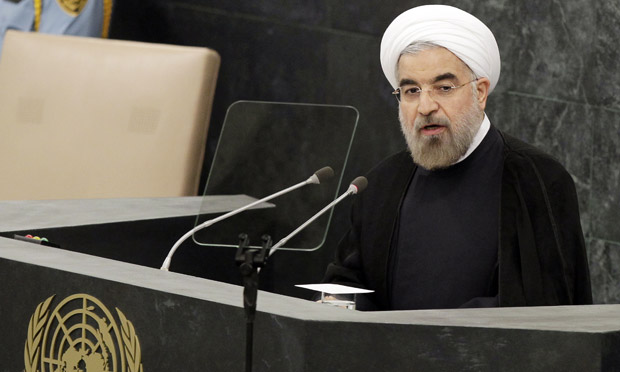
Is Iran's Rouhani A Change For The Better?

 https://static-secure.guim.co.uk/sys-images/Guardian/About/General/2013/9/25/1380115801121/Hassan-Rouhani-speaks-at--011.jpg

 By David Gerstman

It is nearly a year since Iran's President Hassan Rouhani spoke before the United Nations General Assembly.

Later this week he is scheduled to speak again before the General Assembly, but the enthusiasm expressed last year is nowhere to be seen.

In the run up to his speech there was much excitement among the chattering classes. Take, for example, a couple of paragraphs from an editorial in The New York Times from September 22, 2013, a year ago today:
The next few weeks will be critical for capitalizing on a new sense of promise created by a recent flurry of remarkable gestures: Iran’s leadership has sent Rosh Hashana greetings to Jews worldwide via Twitter, released political prisoners, exchanged letters through the Swiss with President Obama, praised “flexibility” in negotiations and transferred responsibility for nuclear negotiations from conservatives in the military to the Foreign Ministry. Mr. Obama eased restraints on humanitarian and good-will activities, including athletic exchanges between the two countries. ...

Mr. Rouhani has a sophisticated, Western-savvy team. His foreign minister, Mohammad Javad Zarif, received degrees from American universities and spent most of his adult life in the United States. Together they have raised expectations in a world eager to see Iran play a more constructive role, and the charm offensive is in full swing. Policy experts, journalists and business people are jockeying to attend a number of invitation-only breakfasts, dinners and meetings scheduled by Mr. Rouhani and Mr. Zarif while they are in New York. There’s a lot riding on their visit this week.
But the "remarkable gestures" that The New York Times cited were remarkable hollow.

Sure,  Rouhani wished Jews of the world a happy new year last year, but he also expressed his support of Hamas to defeat "the Zionist regime," and apparently re-established ties with Hamas.
Yes  Rouhani praised "flexibility" in nuclear negotiations but only demanded flexibility from the West. Now the International Atomic Energy Agency reports that Iran hasn't come clean about the scope of its nuclear program. (Not that Iran's record gave any hope that it would play by the rules.)
The released political prisoners were a sham; often harassed or re-arrested when they were no longer in the public eye. Irwin Cotler recently outlined how human rights have actually gotten worse under Rouhani.

 http://www.ncr-iran.org/en/images/stories/2009/uprising/tehran-dec272009-19-beating.jpg

It would be nice if, having bet on change, the editors of The New York Times would acknowledge that they judged Iran incorrectly.

The most generous interpretation is that Rouhani was simply window dressing; a kinder, gentler face on the real leader of the regime Ayatollah Khamenei. The more likely explanation is that Rouhani is every bit as extreme as the regime (he boasted of expanding Iran's enrichment capability when everyone claimed that he compromised in 2003) but is slightly more pragmatic in his willingness to deal with the West.

 http://www.jihadwatch.org/wp-content/uploads/2014/02/KhameneiRouhani.jpg

Instead of acknowledging that no real change has taken place in Iran, most of those who made the mistake are relatively silent. They know that the evidence proves them wrong, but they would prefer to ignore the evidence than to own up to their cheer-leading of one of the most disastrous foreign policy debacles of our time.

Monday, September 22, 2014

U.S. Middle East Diplomat and Qatar's Money

  http://cdn.timesofisrael.com/uploads/2013/06/Mideast-Qatar-US-Kerr_Horo.jpg

by David Gerstman

The New York Times earlier this month published an expose of how foreign money influenced think tanks. One of the subjects of the article was the Brookings Institution, its vice president Indyk and $14.8 million grant that the government of Qatar had given Brookings. A former scholar at Brookings cautioned that because of Qatar's influence any report coming out of the institution is likely not to be the "full story."

The New York Times didn't seem much concerned with the implication of its reporting but some people did notice.

In Tablet this week Lee Smith pounced on the Times for not looking into the implications of what it reported.
Or maybe the editors decided that it was all on the level, and the money influenced neither Indyk’s government work on the peace process nor Brookings’ analysis of the Middle East. Or maybe journalists just don’t think it’s worth making a big fuss out of obvious conflicts of interest that may affect American foreign policy. Maybe Qatar’s $14.8 million doesn’t affect Brookings’ research projects or what the think tank’s scholars tell the media, including the New York Times, about subjects like Qatar, Hamas, Israel, Turkey, Saudi Arabia, and other related areas in which Qatar has key interests at stake. Maybe the think tank’s vaunted objectivity, and Indyk’s personal integrity and his pride in his career as a public servant, trump the large piles of vulgar Qatari natural gas money that keep the lights on and furnish the offices of Brookings scholars and pay their cell-phone bills and foreign travel.

 http://cdn.timesofisrael.com/uploads/2012/10/Mideast-Palestinians-_Horo2-635x357.jpg

Smith also observed that the Qatar connection made Indyk poorly suited as an interlocutor for both the Israelis and the Palestinians.
Of course, Hamas, which Qatar proudly sponsors, is a problem not just for Israel but also the Palestinian Authority. Which means that both sides in the negotiations that Indyk was supposed to oversee had good reason to distrust an American envoy who worked for the sponsor of their mutual enemy. In retrospect, it’s pretty hard to see how either side could have trusted Indyk at all—or why the administration imagined he would make a good go-between in the first place.
But there's one particular point that's particularly galling, Smith asks "why in the midst of Operation Protective Edge this summer did Kerry seek to broker a Qatari- (and Turkish-) sponsored truce that would necessarily come at the expense of U.S. allies, Israel, and the PA, as well as Egypt, while benefiting Hamas, Qatar, and Turkey?"

Kerry's support of the ceasefire deal that favored Hamas sponsored by Qatar and Turkey raised questions at the time. There  was an Egyptian ceasefire proposal on the table at the time. It's possible (though by no means certain) that if the United States had supported the Egyptian proposal and brought international support behind it, that the war could have been ended a month earlier before hundreds of more people were killed. Did Kerry listen to his compromised former envoy (who said he'd "consult" with the State Department after he resigned) and prolong the war by giving Hamas hope that it could get everything it wanted?
The corrupting influence of Qatar and its effect on the Middle East is something that needs more exposure.

 http://www.english.globalarabnetwork.com/images/stories/2010/Dec/qatar_Emir_Attends_National_Day_Celebrations.jpg

One last note ... when Kerry appointed Indyk, The New York Times ran an editorial that described Indyk as having "a long association with pro-Israel groups." The mention was gratuitous but the suggestion was clear: Indyk might be too pro-Israel to be effective. Now that the Times' own reporting has exposed Indyk's ties to Qatar, will it ask the appropriate question in retrospect?

cross posted at Le·gal In·sur·rec·tion

Friday, August 29, 2014

DIY: How to Booby-Trap Your Home

 http://www.idfblog.com/wp-content/uploads/2014/07/14737219144_1f7d158f92_o-1.jpg

By David Gerstman

On Monday, the IDF translated and published the contents of a Hamas bomb-making manual that it captured during Operation Protective Edge.
The IDF blog quotes from the manual:
The explosives manual recommends teaching civilians how to build and store bombs in their homes. According to the manual, the goal is “to transfer combat from open areas to built-up urban areas, which serves the ‘resistance’ [i.e. Hamas] and fighters of Islamic Jihad.” ...
In an especially incriminating section entitled “Factors for Successfully Hiding Weapons in Homes,” the manual explains how civilians can be used to hide explosives:
“(1) The activity of hiding weapons in homes needs to be done with secrecy and should not have a military character.
(2) Placing equipment in residential areas needs to be done with household items.
(3) You must use residents of the area in order place the equipment inside.”
According to the IDF, Hamas has booby-trapped hundreds of houses in Gaza. In a video (embedded below), IDF soldiers can be seen entering a booby-trapped house.
While the goal of the booby traps may be to kill Israeli soldiers, a Hamas combat manual suggested another reason for using the tactic:

 http://cdn.inquisitr.com/wp-content/uploads/2014/07/Hamas-Uses-Children-Against-Israel.jpg
The destruction of civilian homes: This increases the hatred of the citizens towards the attackers [the IDF] and increases their gathering [support] around the city defenders (resistance forces[i.e. Hamas]).

 Booby-trapping civilians homes is one more documented way that Hamas has  used human shields in violation of international law.