In the first part of
In `Between Iraq and a hard place - Why we went, how it got so screwed up and where it's going , Part 1', I explained that we went to Iraq in the first place in what primarily amounted to a war to protect the Saudis and the other Sunni Emirates in the Persian Gulf.
I showed how President Bush's `Arab Democracy' fetish undercut a brilliant military achievement that could have been the beginning of victory in this war, and how his empowering of the Shiites surprised and horrified the Saudis and undercut our strategic aims.
In Part 2, we'll examine what the Bush Administration is doing now, where Iraq is likely headed and the implications for the Middle East.
The short answer as to where the US is headed in all this is O-U-T, as quickly and as gracefully as we can manage it. I doubt we will have any significant forces left in Iraq by the end of 2007.
With the loss of that `political capital' the President so famously bragged about after the `04 elections, the elevation of many of his most vociferous foes in the opposition to control of the key Congressional committees and his approval ratings consistently in the mid to low 30's, the President's main concern at this point is a face saving exit.
To that end, Dubbyah
appears to have made a deal with al-Maliki and al-Sadr (and thus, Iran) to look the other way while the Shiites complete the ethnic cleansing and marginalization of the Sunnis, and apparently is willing to continue a certain amount of baksheesh and aid to the Iraqi Shiite government in exchange for a reasonably graceful exit.This explains why the Shiite militias have gone to ground and are being allowed to keep their weapons for `home defense' and any Shiites or Sadrists who have been detained have gone quietly, while the Sunni insurgents have been involved in active firefights with US and Iraqi troops. The Shiites know the fix is in, and if it wasn't, Moqtada al-Sadr could, with his parliamentary votes, kick al-Maliki out of office in a heartbeat.
That's why US troops who are part of the `security surge' are patrolling Sadr City in relative peace and quiet, as compared with their attempted incursion a few months ago.
Other signs of the imminent US exit
include a vast step up in Iraqi (almost all Sunni) refugees accepted into the US, the `shared oil revenue' deal the Kurds signed on to to bribe the Shiites to leave them in peace now that they realize the US is leaving, and of course, our
sitting down with Iran and Syria as part of a regional peace conference on Iraq...something the Bush Administration swore it would
never do.
As I've mentioned before, the idea of
`let's talk to Iran and Syria' is simply the latest appeasement Prozac. The only reason for Iran or Syria to talk to the US would be to extract a price. And the fact that the Bush Administration is willing to bargain with them at this point is another indication of the president's desire for the quickest possible exit - regardless of the implications for the future.
What the president has in fact done to deep six the so-called `Bush Doctrine' and to accept, almost in their entirety, the recommendations of the
The Iraq Study Group. The ISG's recommendations, once you get past the bloviated rhetoric could be summarized as follows: let's leave before the next presidential election, let's bribe the Shiite factions to stay quiet long enough for us to make a graceful exit, and let's negotiate with Iran and Syria and give them a free hand in Lebanon and pressure Israel into giving up the Golan Heights, Judea, Samaria and East Jerusalem as part of the price for allowing us to withdraw gracefully.
If this apparent course continues, the implications of this kind of appeasement could by extremely far reaching in the not-too-distant future.
For one thing assuming we paid the price ( or any part of it) demanded by Iran and Syria, the effect it would have on our allies and adversaries both in the region and overseas would be enormous. Should we negotiate our way out of this without neutralizing Iran, it will be seen as what it is....a defeat and a retreat for us and a victory for jihad.
The rationale for all this of course, aside from getting us out of Iraq is that we will have achieved `regional stability' and created a Sunni bloc against the Shiite bloc in Syria, Iran, Iraq and soon, Lebanon. Or as Condi Rice recently put it, there is “a new strategic alignment in the Middle East,” separating “reformers” and “extremists”; she pointed to the Sunni states as centers of moderation, and said that Iran, Syria, and Hezbollah were “on the other side of that divide.”
Did you ever think you'd hear an intelligent person refer to Saudi Arabia, Egypt or Dubai as `moderate' with a straight face?(You'll also notice she didn't mention Hamas)
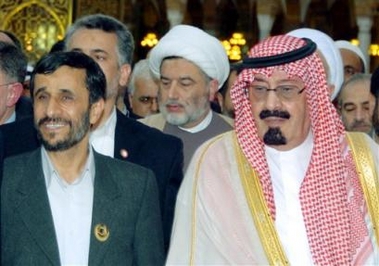
That attitude also assumes that the Sunni agenda lines up perfectly with our own - which is definitely not the case. And the proof of that was the sitdown between Iran's Ahmadinejad and Saudi King Abdullah, to horsetrade for spheres of influence and plan strategy for goals they have in common - like the destruction of Israel and the Jews.
When it comes to dealing with jihad and non-believers, Sunnis and Shia are perfectly capable of putting aside their differences for the moment and working together for common aims.
We are in the process , in effect, of handing a huge victory to Iran. The country's Supreme Leader, Ayatollah Ali Khamenei was entirely correct when he said on Iran state television that “realities in the region show that the arrogant front, headed by the U.S. and its allies, will be the principal loser in the region.”
Iran is in dire straits economically and needed to expand or implode. Assuming that the Bush Administration has no intention of neutralizing them or doing anything meaningful to prevent Iran from getting nuclear weapons, that particular genie is out of the bottle, with consequences scarcely to be imagined, as Iran will dominate the new Shiite Iraq, its resources and its strategic location.
Another implication of this appeasement has to do with the effect on our friends and allies in the region.
Our real ally in Iraq,the Kurds, as I've mentioned, are already in the process of jumping ship, since we've left them no choice. Elsewhere in the region, moderate forces like the Iranian dissidents and Lebanese Christians and pro-democracy forces will receive a definite message that our commitments are not to be trusted. And should Israel be marginalized, we will have lost an important ally, one of the few we have with a significant military component.
Most important, of course, is the effect on America and its ability to wage the War on Jihad. One of the worst side effects of the way the Bush Administration has managed this war, and something President Bush will eventually answer for to history was his refusal to channel the USA's natural rage and energy after 9/11 into victory over our enemies.
Instead, we were told that our enemies' creed was peace, that the perpetrators of 9/11 would be `brought to justice' and to calm down and go shopping.
The poor planning, misrepresentation and outright waste of the Iraq War is not something Americans are going to forget easily. It has divided us when we should have been unified, and will effect us in taking steps we should take to win the War on Jihad.
Should we leave the region for another isolationist vacation from history, rest assured that the war will follow us home.

 12 year old Darfur rape victim